

Varroa Resistance: What It Means for Your Apiary
23 March 2026 Recent confirmation of pyrethroid-resistant varroa mites in parts of northern New South Wales and southeast Queensland has understandably raised concern across the industry. For many beekeepers, this is […]
Recent confirmation of pyrethroid-resistant varroa mites in parts of northern New South Wales and southeast Queensland has understandably raised concern across the industry. For many beekeepers, this is the first real signal that resistance—something widely reported overseas—has now arrived in Australia.
However, it’s important to approach this with a clear understanding of what resistance actually means in practice, and what it doesn’t.
What has been found
A beekeeper in northern NSW reported poor treatment efficacy from Bayvarol (active ingredient is flumethrin). Bayvarol is part of the pyrethroid family of chemicals which includes Apistan. All pyrethroids share the same mode of action. Genomic testing confirmed that 100% of the mites tested so far carry resistance mutations at a key position (L925) in the genome. The mutations at the L925 position, known as L925I and L925M, blocks/interferes with the pathway that Bayvarol and Apistan work through. This combination of mutations is common in north America and parts of Europe.
Further sampling of hives in SE QLD has identified mites carrying resistance mutations at the same L925 position, inferring very strong heritable resistance to Bayvarol. Further testing across SE QLD of beekeepers who have reported poor efficacy from Bayvarol has also confirmed several new sites, all with strong double gene mutations. There are some known links between apiaries but further tracing is occurring which will be important to determine if it is natural spread or hive movements.
At this stage based on the current limited testing, resistant mites appear to be localised to a relatively small geographic area and have mainly been identified in situations where treatments have not performed as expected. Testing of apiaries around the identified resistant apiaries has shown no mutations and a high level of susceptibility to Bayvarol. This is important as currently the tested mites have either been 100% resistant or highly susceptible with no in-between which is not what you would expect if it was locally grown resistance.
This indicates there is a strong likelihood that this could be a new varroa population entering Australia, rather than resistance developing from the existing mite population. That distinction matters, because it suggests this is not yet a widespread national issue—but it does reinforce the ongoing importance of biosecurity vigilance.
What about Virus Testing?
Importantly, virus testing has not detected any new or exotic viruses therefore not yet providing clear evidence to confirm whether this represents a new incursion or local evolution. Further specialised testing of the Rabdo virus is continuing to help understand how closely related that virus is to original Newcastle mites that hosted the Rabdo virus. If the Rabdo virus testing indicates genetic differences or ‘distance’ then this could indicate it is newly introduced population to Australia.
So, what is miticide resistance?
In simple terms, miticide resistance is a genetic survival trait. Within any mite population, there can be a small number of individuals that naturally survive a treatment. When those mites reproduce, they pass that survival trait on to the next generation. Over time—and particularly if the same treatment is used repeatedly—the selection pressure disproportionally increases resistant mites.
With pyrethroids, this resistance is caused by a genetic change that affects how the mite’s nervous system responds to the chemical. The result is that the treatment becomes gradually less effective against the resistant mites over time.
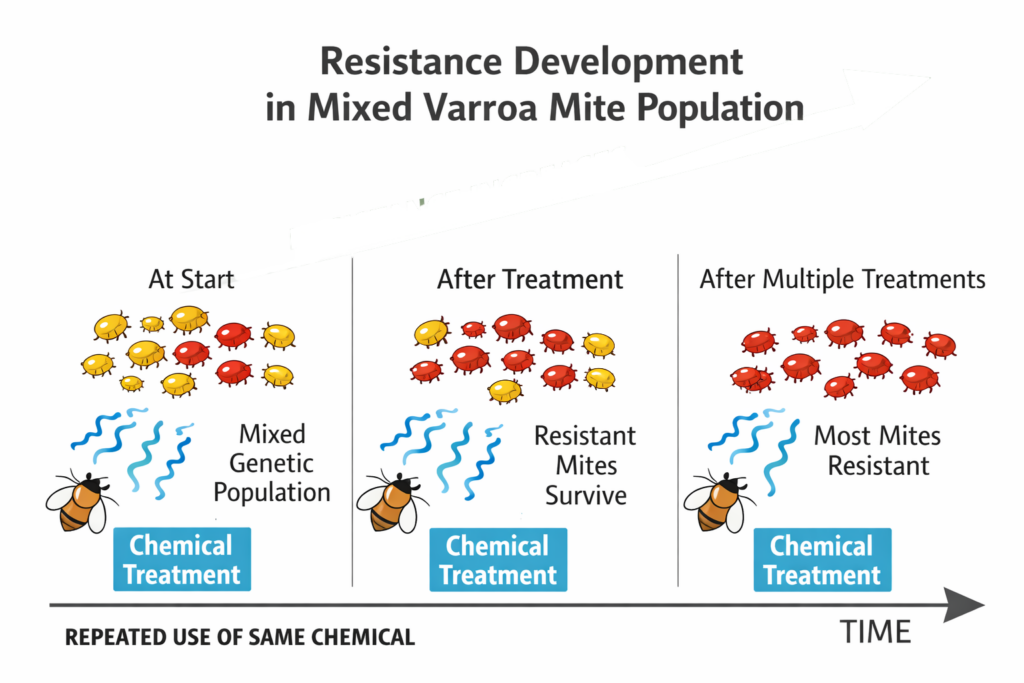
It’s important to stress that resistance does not mean a product suddenly stops working altogether. Instead, it means that its effectiveness is reduced against that particular population over time. Outside of the identified apiaries, pyrethroid treatments are still working well and remain a useful tool when used correctly.
Will resistant varroa spread rapidly?
A key question for many beekeepers is whether this resistance will now spread rapidly across the country. The evidence suggests that it will not—provided it is managed properly.
Globally these resistance traits are considered recessive, meaning a mite needs two copies of the gene (homozygous) to express strong resistance. When resistant mites mix with non-resistant mites, that trait is diluted in the population. This mixing with susceptible mite populations naturally slows the rate at which resistance builds in a population. Combined with miticide group rotations and the currently limited distribution, this means resistance is unlikely to move quickly across Australia on its own.
Affected Beekeeper?
Where resistance can build more rapidly is at the apiary level, particularly where the same chemical group is used repeatedly without rotation and/or without checking whether treatments have actually worked.
This is where beekeeper’s responsible hive management becomes critical.
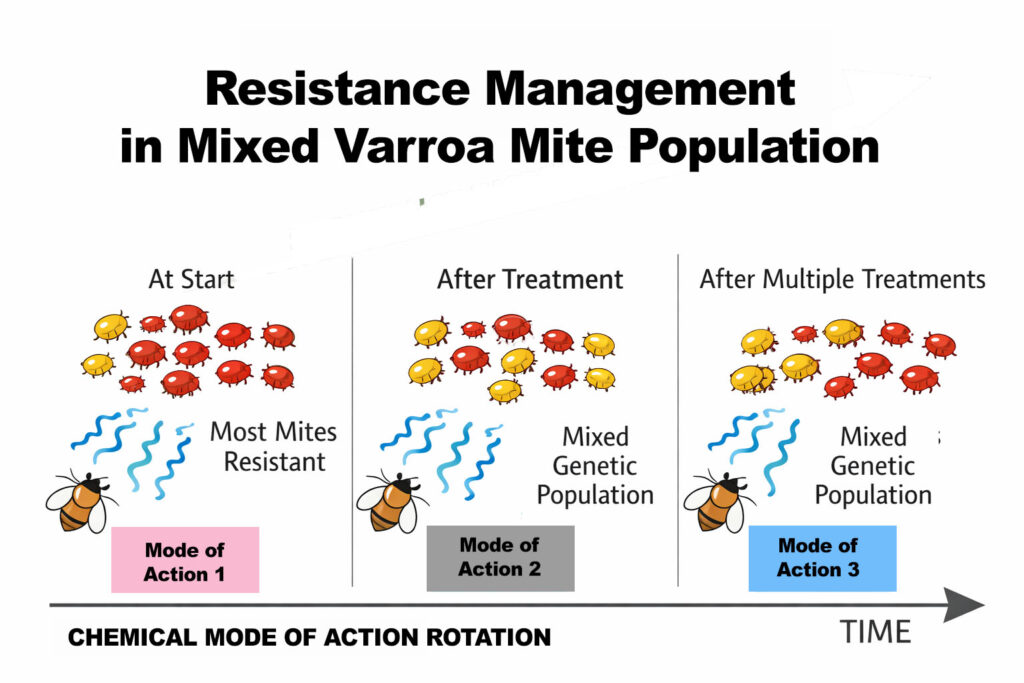
The single most effective way to limit resistance is to rotate chemical groups, rather than relying on one product or one mode of action. For example, a beekeeper might use an amitraz-based treatment in one cycle, followed with an organic acid such as formic or oxalic acid in the next, and then return to a pyrethroid if it is still proving effective. This approach reduces the selection pressure on any one chemical group and helps preserve their usefulness over time.
Equally important is the need to check treatment efficacy every time. Too often, treatments are applied and assumed to have worked. Simple monitoring before and after treatments provides a clear indication of whether mite levels have actually been reduced. If mite numbers remain high after treatment, it should be assumed that the product has not worked effectively—whether due to resistance or other factors—and a different chemical group should be used immediately.
It is also important not to overreact. Pyrethroids remain an important part of the varroa management toolkit for the majority of Australia beekeepers and should not be abandoned unnecessarily. When used at the correct dose, at the right time, and within a proper rotation, they will continue to play a role in many beekeeping operations.
What this situation does highlight is that resistance is not a distant or theoretical issue—it is now something Australian beekeepers need to proactively manage. The good news is that, with the right practices including chemical rotation, its development and spread can be significantly slowed.
The bottom line is straightforward. Resistance has been detected, but it is currently limited and manageable. There is a strong possibility it is linked to a new population, rather than widespread failure of treatments across Australia. Most importantly, it is not something that will spread uncontrollably if beekeepers apply good management practices.
The decisions made in each apiary—particularly around chemical treatment rotation and monitoring—will determine the speed of resistance development and population spread from here.
Handled well, Australia still has a strong opportunity to maintain effective varroa control tools for many years to come.
Article written by: Danny LeFeurve CEO AHBIC
Reviewed by Dr Chris Anderson, Jon Lockwood, Rob Stephens, Dr Doung Nguyen