
Honey Trace – A Honey Traceability System to Protect Australian Honey
23 September 2026Article by Alan Dorin Monash University, September 2026. To achieve premium prices for Australian honey, we need it to become a trusted global brand. Our native flora, extensive forests […]
Article by Alan Dorin Monash University, September 2026.
To achieve premium prices for Australian honey, we need it to become a trusted global brand. Our native flora, extensive forests and wilderness areas are prized overseas for their potential to produce world class honeys of unique character. But honey fraud is of ongoing global concern. Many buyers are turning to their local products to reduce the likelihood of buying adulterated or mislabelled international honey. How can we convince them that Australian honey is authentic, and every bit as pure as we claim? The answer lies in a honey traceability system.
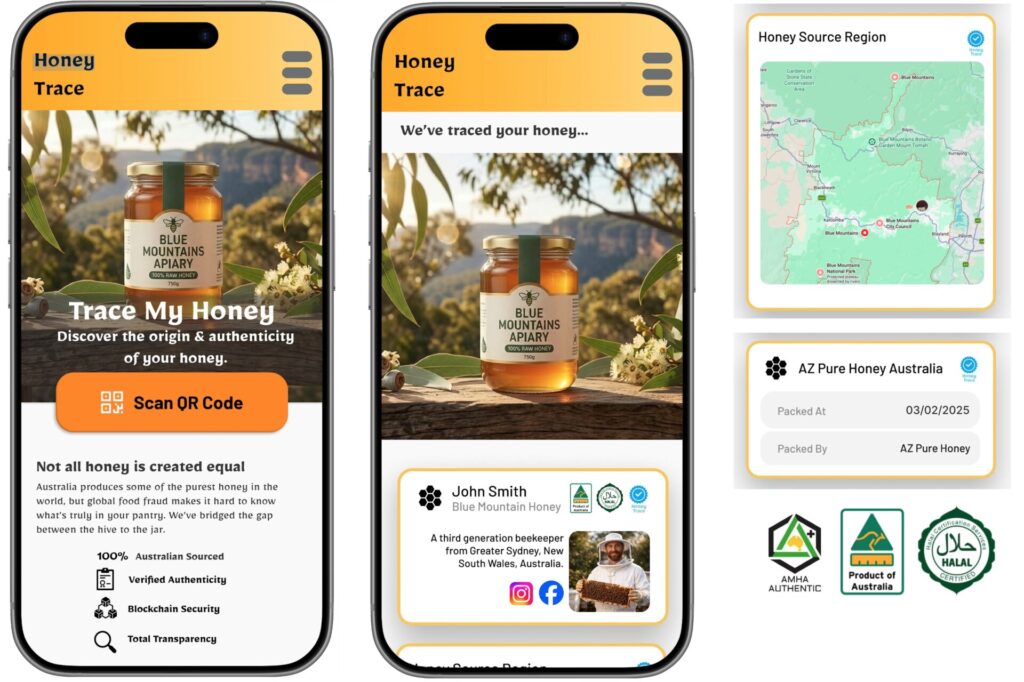
Monash University and the Northern Territory Government Department of Agriculture and Fisheries have developed Honey Trace. This is a honey traceability system that follows honey from Australian beekeepers along national or international supply chains, through to the kitchen table of its consumers. It allows the consumers of our products to verify that the honey they have purchased is genuine.
This project received grant funding from the Australian Government’s Department of Agriculture, Fisheries and Forestry under the Building Trust in Australian Agricultural Traceability and Credentials in Southeast Asia program, and was supported by AHBIC.
Research and development was driven by stakeholder engagement with Australian beekeepers, bee and honey technology developers, honey packers, Southeast Asian distributors, Australian honey certification bodies, and AHBIC.
Honey Trace provides capabilities at the cutting edge of global systems for food traceability and provenance verification. It supports mass balance checking, secure collection of digitally verified apiary and honey extraction data and certification management. The system enables beekeepers to control and negotiate data sharing within a supply chain, and ultimately to trace national and international honey movement and sales. The system is backed by simple, efficient QR code scanning, blockchain security and cloud data accessibility that operates on mobile devices with or without internet connectivity, and from the desktop via the web. By storing its data using blockchain, Honey Trace’s ledger provides a globally approved, digitally authenticated and independent method to ensure supply chain data is tamper-proof. It enables stakeholders to check claims about Australian honey’s provenance and authenticity. It is reconfigurable to allow for the introduction of new secure traceability technologies as they emerge.
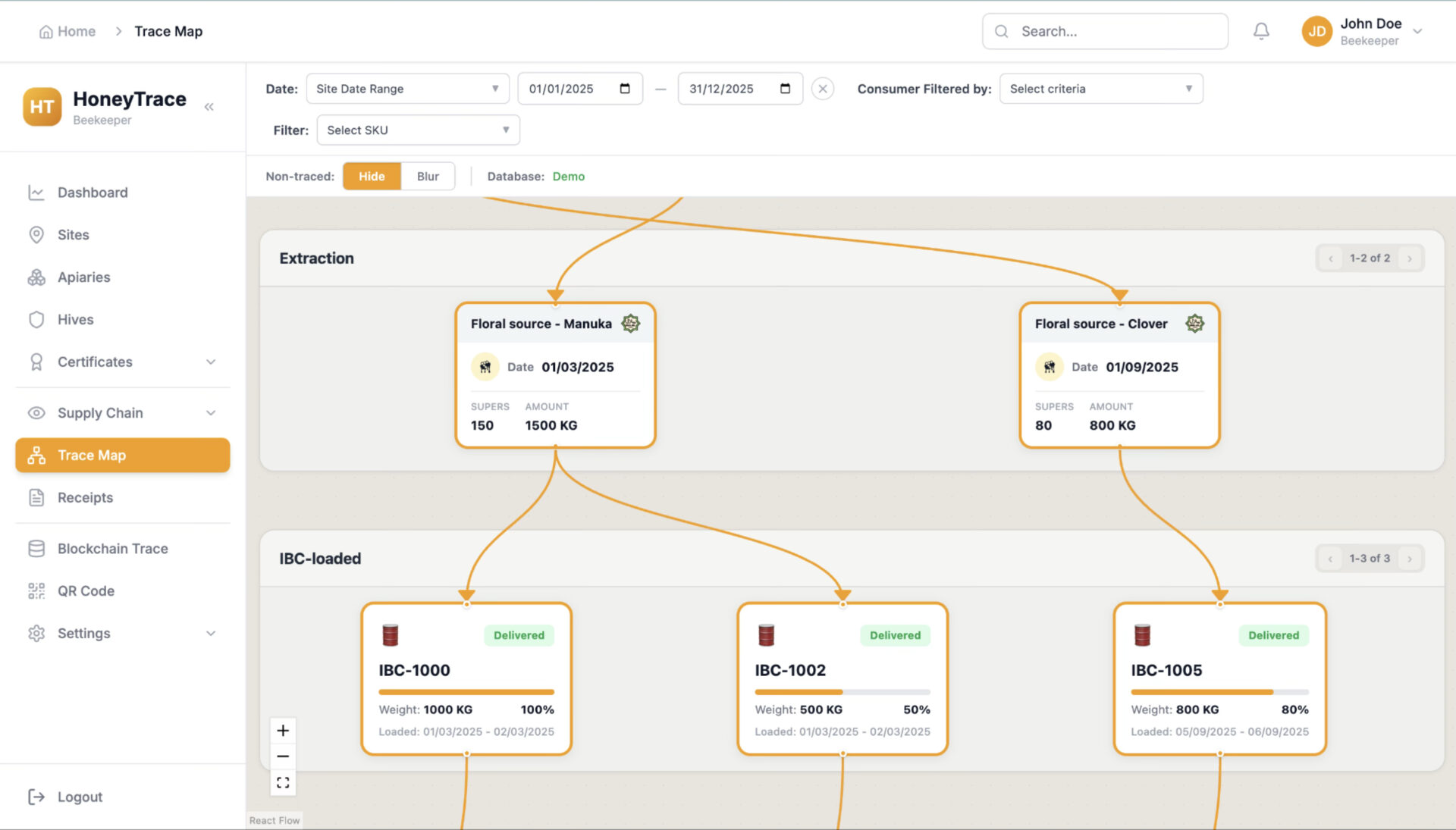
Features of the system include:
- Site creation and apiary movement management.
- Extraction and IBC data collection.
- Certification inputs (e.g. B-Qual, Halal Certification)
- Honey trait data entry
- Honey blend information management
- Batch number allocation (automatic or manual)
- QR code generation for apiaries, IBCs, packing boxes, honey labels
- Dispatch and receival information entry
- Inventory availability records
- Customer profile data
- Beekeeper profile visibility to customers (optional, under beekeeper control)
Honey Trace was recently tested end-to-end under simulated conditions by an Australian beekeeper and a large commercial Australian honey packer. A simulated sales order was shipped and tracked to a Southeast Asian distributor and retailer where it was followed to a consumer in Singapore. The project has been demonstrated and presented at state apiary association conferences and field days in NSW, Victoria and the Northern Territory.
We are now seeking interested parties to move the project on to the next phase enabling it to become a viable system for Australia’s honeybee industry.
If you’re interested in being involved in any way, please contact the project lead, Alan Dorin by email on alan.dorin@monash.edu. We’d love to hear from you.
