

AFB – Bee Informed, from our WA Bee Biosecurity Officer: Shannon Holt
24 August 2026Spring build-up…or hidden trouble? Article by Shannon Holt, Bee Biosecurity Officer DPIRD WA Spring is one of the busiest times in the apiary. Colonies are expanding rapidly, brood nests are growing and management activities are […]
Spring build-up…or hidden trouble?
Article by Shannon Holt, Bee Biosecurity Officer DPIRD WA
Spring is one of the busiest times in the apiary. Colonies are expanding rapidly, brood nests are growing and management activities are ramping up. While colonies may appear healthy and productive, hidden problems can also emerge, particularly American foulbrood disease (AFB), caused by the bacterium, Paenibacillus larvae. However, AFB doesn’t always present in the textbook way many beekeepers expect. Knowing what to look for and carrying out thorough brood inspections in spring can make all the difference to detecting AFB before it spreads.
Best practice, as outlined in the Biosecurity Code of Practice, is to conduct detailed brood inspections at least three times a year: spring, summer and autumn. Spring inspections are particularly important because they often provide the first opportunity to detect AFB following winter.
Why spring reveals what winter hides
Spring doesn’t cause AFB infections. However, seasonal changes in colony behaviour and increased management activities can make previously hidden infections more obvious and increase the risk of disease spreading within an apiary.
Colony dynamics
If AFB spores are present in a colony’s honey or pollen stores, the rapid increase in brood rearing during spring increases the likelihood they will be fed to young larvae. Research shows as little as 6–10 spores may be sufficient to infect a one-day-old larva. As nurse bees feed larvae and clean brood cells, they can inadvertently distribute spores more widely through the brood nest.
Spring can also bring periods of nutritional stress due to variable weather, interrupted nectar flows or limited forage, particularly as colonies rapidly expand. Weakened colonies are more vulnerable to robbing, one of the main ways AFB spreads between hives. Increased bee traffic and drifting within apiaries can create additional opportunities for disease transmission.
Beekeeper activity
“You can’t find what you don’t look for.”
Brood inspections are often limited over winter, so spring may be the first thorough inspection carried out in several months. As a result, many cases of AFB are first detected during spring inspections. Spring management activities such as colony splitting, honey harvesting and transferring frames can also spread AFB if good biosecurity practices aren’t followed.
Recognising AFB: Common signs 🔍
The following signs commonly occur in colonies affected by AFB, although not every infected colony will display all of them.
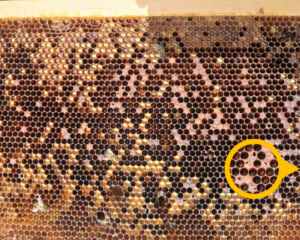
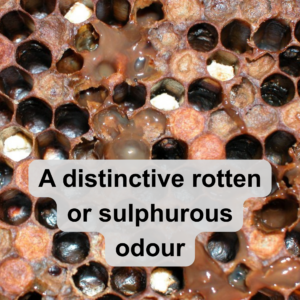
Spotty or irregular brood pattern, with perforated brood cappings, holes are often off-centre.
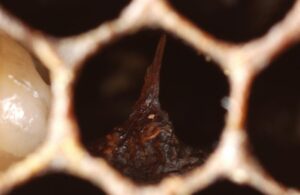
Protruding pupal ‘tongue’, where brood has developed to the pupal stage before dying.
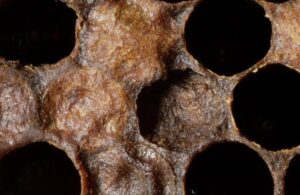
Dark, sunken cappings that may appear greasy.
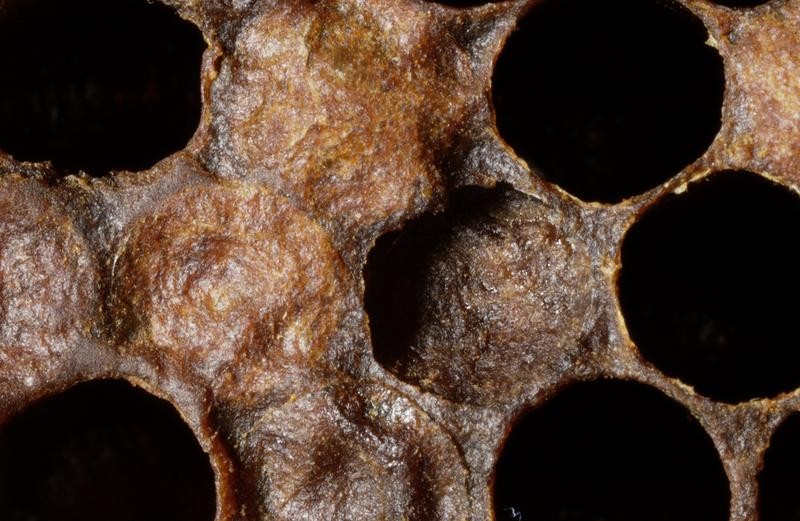
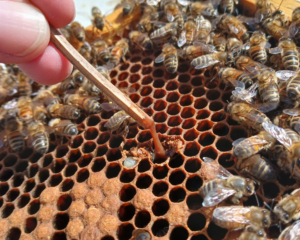
Decaying Larvae form a light to dark brown, semi-fluid mass which can stretch in to a smooth, elastic rope when tested with a stick (ropiness test).
What if you suspect AFB but it doesn’t rope?
Ropiness is a useful field diagnostic because no other brood disease produces the same characteristic rope. It occurs only during a specific stage of larval decomposition, when diseased brood breaks down into a sticky, glue-like mass.
To perform the test, insert a matchstick into a suspect cell, stir gently, then slowly withdraw it. If the brown larval remains stretch into a smooth rope approximately 3–5 cm long, AFB is confirmed.
A negative ropiness test does not rule out AFB. There is only a limited period during which infected larvae will rope:
- Too early: the larva has not yet reached the ropey stage (commonly less than 8–12 days post-infection*)
- Too late: the larval remains have dried into a hard scale (commonly more than 3–4 weeks after infection*)
*Disease progression also depends on the age of the larva at infection, spore dose and AFB strain.
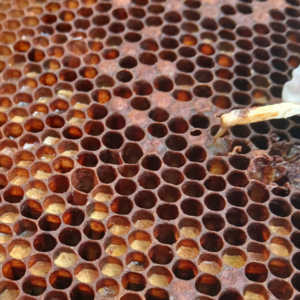
If you suspect AFB, even if larval remains are not roping:
- Look for other symptoms described above
- Examine multiple cells, as some may be at a different stage of infection and more likely to rope
- Recheck suspect frames for ropiness several days later
- Isolate the hive and reduce the entrance to minimise robbing
- Avoid moving equipment between colonies
- Clean tools and hands or gloves before working other hives
- Contact DPIRD for assistance with sample collection and laboratory testing.
If AFB is confirmed, either through visual diagnosis or laboratory testing, the affected hive must be euthanised and all associated equipment destroyed or appropriately sterilised. AFB is a declared and reportable disease, and all detections must be reported to DPIRD as soon as practicable.
Biosecurity reminders
✅ Maintain clear hive-group barriers and avoid swapping supers, frames, or comb between these hive groups.
✅ Clean hive tools between hives or hive groups.
✅ Carefully inspect brood during spring build-up and investigate any unusual brood patterns or signs of disease.
🧬 Why some AFB infections are harder to spot
Two strains of the AFB bacterium are known to occur in Western Australia. These strains differ in how quickly they kill larvae, which influences the signs beekeepers see during brood inspections.
Strain I typically produces the classic signs associated with AFB. Infected larvae usually die around 12 days after infection, after the brood cell has been capped1,2. This allows symptoms such as sunken or perforated cappings and protruding pupal tongues to develop. Many infected larvae remain in the hive long enough to become ropey and eventually dry into scales.
Strain II can be much harder to detect. Infected larvae usually die just 3–7 days after infection, often before cells are capped¹⁻³. As a result, classic signs such as sunken cappings, perforated cappings and protruding pupal tongues may never develop. Research has also shown that hygienic bees remove around 90% of Strain II-infected larvae before 13 days post-infection, compared with about 64% of larvae infected with Strain I³. Many infected larvae are therefore removed before they become ropey or dry into scales.
The key message is that not all AFB infections display the classic signs. While sunken cappings, ropiness and scale remain important indicators, their absence does not rule out AFB. Colonies infected with Strain II may show only subtle signs, such as an irregular brood pattern, making careful brood inspections and laboratory testing particularly important whenever something doesn’t look right.
A case study: An unusual presentation of AFB
Earlier this year, an experienced beekeeper noticed something wasn’t quite right in one of their nucleus colonies. The queen appeared to be failing, resulting in a shrinking brood nest and declining adult bee numbers. The weakened colony also developed secondary problems, including chilled brood and chalkbrood.
Although these issues could readily explain the colony’s condition, the beekeeper remained suspicious of AFB. There was a faint decaying odour, and dead larvae were present in both capped and uncapped cells. Brown larval remains were visible, but the ropiness test was negative.
It would have been easy to conclude that the colony was simply suffering from queen failure and its associated complications. Instead, samples were submitted for laboratory testing, which later confirmed AFB.
This case illustrates that multiple problems can occur in the same colony, and AFB does not always present in the textbook manner. When brood abnormalities cannot be fully explained, or something simply doesn’t look right, laboratory testing can help detect infections that might otherwise be missed.
Rather than waiting for laboratory confirmation, the beekeeper treated the nuc as a suspected AFB case and acted immediately. The affected nuc was isolated, repeated brood inspections were carried out across all the beekeeper’s apiaries, and proactive Honey Culture Tests (HCT) were undertaken. Thanks to this early response, no additional cases of AFB have been detected in the six months since the initial diagnosis.
Get ahead of AFB – Honey Culture Tests
HCT is particularly valuable because it can detect AFB before obvious clinical signs develop. Used alongside barrier systems, good hive hygiene and strong biosecurity practices, HCT can provide important information to help reduce the spread and impact of AFB within your apiary.
Current costs (in WA) are $92.65 per honey sample, plus a $34.73 job handling fee. For more information go to 👉 www.dpird.wa.gov.au/businesses/biosecurity/diagnostics-and-laboratory-services/animal-pathology/
Suspect AFB? Report it promptly
In WA:
📧 Email: pbhoney@dpird.wa.gov.au
📱 Online reporting tool: MyPestGuide Reporter App
☎️ Phone: 08 9368 3080 (Pest and Disease Service)
This spring, careful brood inspections, investigating unusual brood, and early isolation of suspect colonies remain your best defence against AFB.
References
- Beims, H. et al. (2020). Discovery of Paenibacillus larvae ERIC V… International Journal of Medical Microbiology.
- Genersch, E. (2005). Strain- and Genotype-Specific Differences in Virulence of Paenibacillus larvae… Applied and Environmental Microbiology.
- Rauch, S. et al. (2009). Negative Correlation between Individual-Insect-Level Virulence and Colony-Level Virulence of Paenibacillus larvae…Applied and Environmental Microbiology.
