Honey Bee
← Back

Newsletter Edition - March 2026

  • CEO Update March 2026

    CEO Report March 2026

    The first few months of 2026 have reinforced just how rapidly the operating environment for Australian beekeepers is changing. Varroa is now an established reality across much of the eastern seaboard, and industry continues to adapt to varroa management. At the same time, seasonal conditions and ongoing cost pressures are continuing to challenge profitability for many businesses.

    Honey production appears to average to well below average across most areas. Small increases in honey prices have been welcomed by many but for some the price is almost irrelevant if they don’t have any to sell. South Australian beekeepers have reported another terrible production season for the second year in a row. NSW and QLD beekeepers have been reporting average yields which is similar to WA and Tas.

    Fuel Crisis

    Both Jon and I have been participating in a number of forums conveying the importance of the honeybee industries access to fuel. This has included attending the National Emergency Management Agencies – National Coordination Mechanism meetings. We have been proactively communicating the importance of our industry and the impacts to the broader agricultural sector and food security if rationing was implemented and our industry wasn’t prioritised. We will keep representing our industry at the different forums as the situation develops.

    Operation Decker – Federal Investigation into Varroa

    AHBIC has been actively vocalising our concerns around the recent findings that have been published by DAFF into the varroa incursion.  We believe the industry deserves a deeper response than what has been handed down. We will continue to demand from the Australian Government a deeper review that industry can use to better inform our industry biosecurity investments.

    Varroa resistance to pyrethroids

    Several apiaries in Northern NSW and Southeastern QLD have been detected with gene mutations for resistance.  This is a terrible development for the industry that is already struggling to adapt and manage mite populations.  It is still early days in terms of understanding the spread and if it is locally developed resistance or a new population of mites. I have written a more detailed separate article in this newsletter detailing the situation as it currently stands.

    Imported Honey

    DAFF have received the results of the honey testing program from the National Measurement Institute Labs and are in the process of interoperating the results. AHBIC are maintaining close communications with the DAFF team and will provide further updates as they come available.

    We continue to pursue suspected adulterated honey on shelves and report mislabelling of products claiming to be honey, not derived from bees to food authorities and the ACCC.

    AHBIC board meeting

    AHBIC meets face to face twice a year, once at the AGM in July and once early in the year. The rest of the AHBIC board meetings are conducted online to save time and money.  We always make the most of the face-to-face meetings by holding several workshops around the board meeting to deep dive on strategy and hot button topics.

    In late February the AHBIC board met in Lismore, hosted by the Southern Cross University.  The board workshopped a wide range of topics including AHBIC’s communication strategy, a check-in against strategic plan progress and AGM motions, as well as planning for the 2026 AGM in Launceston.

    At this years AGM there will be two board vacancies for election. If you are passionate about our industry and want to shape the national industry policies and direction, then think about putting your hand up to join the AHBIC board in July 2026. Get in contact if you would like to know more about the process.

    National Food Security Strategy

    The federal government have highlighted food security as a focus area for the Albanese Government. AHBIC has been working hard to ensure honey bees are included in the conversation as the enabler that underpins food security in Australia.  As a result, AHBIC has provided submissions, attended national food security workshops and been involved in thought pieces underscoring the importance of honey bees.

    It is important that our industry is loud in the food security discussion and I encourage you to participate in the national discussion where you can. Feeding Australia

    Maximum Residue Limits (MRL’S)

    MRL’s are set by the Food Standards Australia and New Zealand (FSANZ) across all food sectors. MRL’s are in place for all miticide treatments to ensure any honey sold is safe and of high quality. AHBIC has recently learned that FSANZ has lowered the MRL for fluvalinate (Bayvarol) from 0.005 mg/kg to 0.003 mg/kg. AHBIC was not consulted nor aware of any work to amend the MRL. We are looking into the reasoning for the changes and will report back when we have more information, until then we have updated information on our website regarding laboratory testing capabilities down to 0.003mg/kg, Maximum Residue Limits – Australian Honey Bee Industry Council

    Red Dwarf Honey Bee Incursion – Burrup Peninsula WA

    This response has now moved into a proof of freedom phase with no new sightings or detections of RDHB since July 2025. This is an excellent outcome for the WA response team in extremely challenging conditions. The Honey Bee industry, as the only financially contributing industry, has agreed to cost share the response at 2.5%, which will be paid for by the biosecurity response levy.

    The Month Ahead

    In the lead up to Easter AHBIC is busy pulling together communications for the levy reform proposal and developing the online ballot with the aim of starting the roll out of the communications this month. The levy reform project is a big piece of work for AHBIC and will consume a lot of our time over the next few months.

    We will continue to represent our industry at the various fuel crisis forums, work with the jurisdictions around varroa and resistance, help those states free of varroa to plan and continue working with DAFF around imported honey.

    I hope the rest of your honey season is good and hopefully the rain across the southern regions of Australia will provide some honey to finish the season.

    Danny LeFeurve

    CEO
  • Varroa Resistance: What It Means for Your Apiary


    Recent confirmation of pyrethroid-resistant varroa mites in parts of northern New South Wales and southeast Queensland has understandably raised concern across the industry. For many beekeepers, this is the first real signal that resistance—something widely reported overseas—has now arrived in Australia.

    However, it’s important to approach this with a clear understanding of what resistance actually means in practice, and what it doesn’t.

    What has been found

    A beekeeper in northern NSW reported poor treatment efficacy from Bayvarol (active ingredient is flumethrin). Bayvarol is part of the pyrethroid family of chemicals which includes Apistan. All pyrethroids share the same mode of action. Genomic testing confirmed that 100% of the mites tested so far carry resistance mutations at a key position (L925) in the genome. The mutations at the L925 position, known as L925I and L925M, blocks/interferes with the pathway that Bayvarol and Apistan work through. This combination of mutations is common in north America and parts of Europe.

    Further sampling of hives in SE QLD has identified mites carrying resistance mutations at the same L925 position, inferring very strong heritable resistance to Bayvarol. Further testing across SE QLD of beekeepers who have reported poor efficacy from Bayvarol has also confirmed several new sites, all with strong double gene mutations. There are some known links between apiaries but further tracing is occurring which will be important to determine if it is natural spread or hive movements.

    At this stage based on the current limited testing, resistant mites appear to be localised to a relatively small geographic area and have mainly been identified in situations where treatments have not performed as expected. Testing of apiaries around the identified resistant apiaries has shown no mutations and a high level of susceptibility to Bayvarol. This is important as currently the tested mites have either been 100% resistant or highly susceptible with no in-between which is not what you would expect if it was locally grown resistance.

    This indicates there is a strong likelihood that this could be a new varroa population entering Australia, rather than resistance developing from the existing mite population. That distinction matters, because it suggests this is not yet a widespread national issue—but it does reinforce the ongoing importance of biosecurity vigilance.

    What about Virus Testing?

    Importantly, virus testing has not detected any new or exotic viruses therefore not yet providing clear evidence to confirm whether this represents a new incursion or local evolution. Further specialised testing of the Rabdo virus is continuing to help understand how closely related that virus is to original Newcastle mites that hosted the Rabdo virus. If the Rabdo virus testing indicates genetic differences or ‘distance’ then this could indicate it is newly introduced population to Australia.

    So, what is miticide resistance?

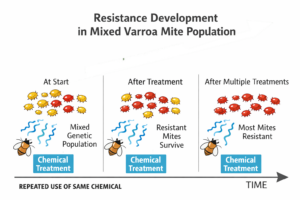
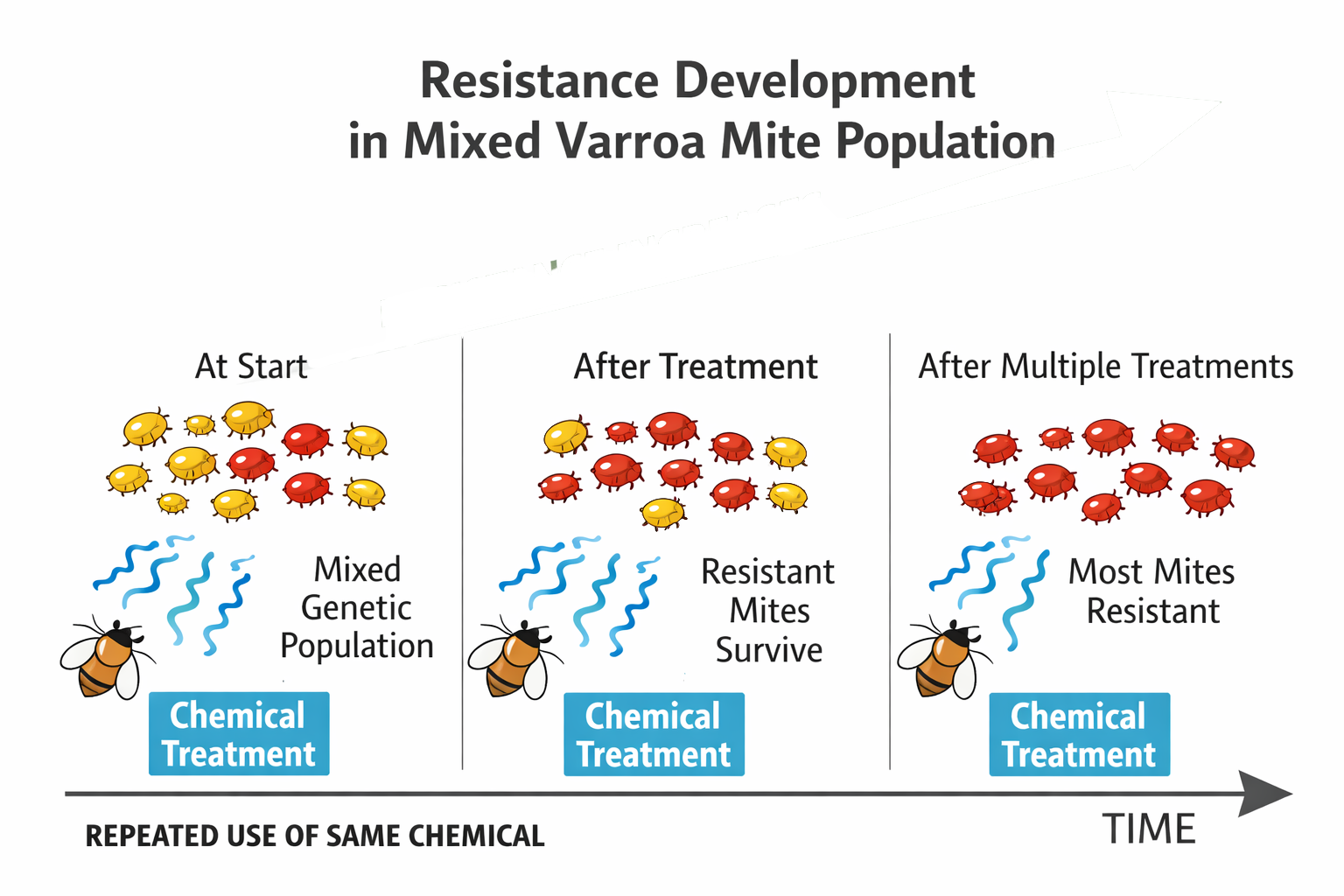
    In simple terms, miticide resistance is a genetic survival trait. Within any mite population, there can be a small number of individuals that naturally survive a treatment. When those mites reproduce, they pass that survival trait on to the next generation. Over time—and particularly if the same treatment is used repeatedly—the selection pressure disproportionally increases resistant mites.

    With pyrethroids, this resistance is caused by a genetic change that affects how the mite’s nervous system responds to the chemical. The result is that the treatment becomes gradually less effective against the resistant mites over time.

    Image 1: Example of resistance development occurring due to repeated use of same Chemical mode of action; Red = resistance mites, yellow = susceptible mites.

    It’s important to stress that resistance does not mean a product suddenly stops working altogether. Instead, it means that its effectiveness is reduced against that particular population over time. Outside of the identified apiaries, pyrethroid treatments are still working well and remain a useful tool when used correctly.

    Will resistant varroa spread rapidly?

    A key question for many beekeepers is whether this resistance will now spread rapidly across the country. The evidence suggests that it will not—provided it is managed properly.

    Globally these resistance traits are considered recessive, meaning a mite needs two copies of the gene (homozygous) to express strong resistance. When resistant mites mix with non-resistant mites, that trait is diluted in the population. This mixing with susceptible mite populations naturally slows the rate at which resistance builds in a population. Combined with miticide group rotations and the currently limited distribution, this means resistance is unlikely to move quickly across Australia on its own.

    Affected Beekeeper?

    Where resistance can build more rapidly is at the apiary level, particularly where the same chemical group is used repeatedly without rotation and/or without checking whether treatments have actually worked.

    This is where beekeeper’s responsible hive management becomes critical.

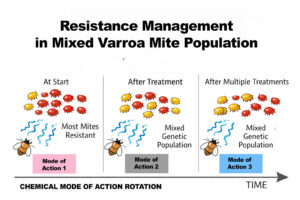
    The single most effective way to limit resistance is to rotate chemical groups, rather than relying on one product or one mode of action. For example, a beekeeper might use an amitraz-based treatment in one cycle, followed with an organic acid such as formic or oxalic acid in the next, and then return to a pyrethroid if it is still proving effective. This approach reduces the selection pressure on any one chemical group and helps preserve their usefulness over time.

    Equally important is the need to check treatment efficacy every time. Too often, treatments are applied and assumed to have worked. Simple monitoring before and after treatments provides a clear indication of whether mite levels have actually been reduced. If mite numbers remain high after treatment, it should be assumed that the product has not worked effectively—whether due to resistance or other factors—and a different chemical group should be used immediately.

    It is also important not to overreact. Pyrethroids remain an important part of the varroa management toolkit for the majority of Australia beekeepers and should not be abandoned unnecessarily. When used at the correct dose, at the right time, and within a proper rotation, they will continue to play a role in many beekeeping operations.

    What this situation does highlight is that resistance is not a distant or theoretical issue—it is now something Australian beekeepers need to proactively manage. The good news is that, with the right practices including chemical rotation, its development and spread can be significantly slowed.

    Image 2: Example of resistance management involving rotation of Chemical mode of action; Red = resistance mites, yellow = susceptible mites.


    The bottom line is straightforward. Resistance has been detected, but it is currently limited and manageable. There is a strong possibility it is linked to a new population, rather than widespread failure of treatments across Australia. Most importantly, it is not something that will spread uncontrollably if beekeepers apply good management practices.

    The decisions made in each apiary—particularly around chemical treatment rotation and monitoring—will determine the speed of resistance development and population spread from here.

    Handled well, Australia still has a strong opportunity to maintain effective varroa control tools for many years to come.

    Article written by: Danny LeFeurve CEO AHBIC

    Reviewed by Dr Chris Anderson, Jon Lockwood, Rob Stephens, Doung Nguyen

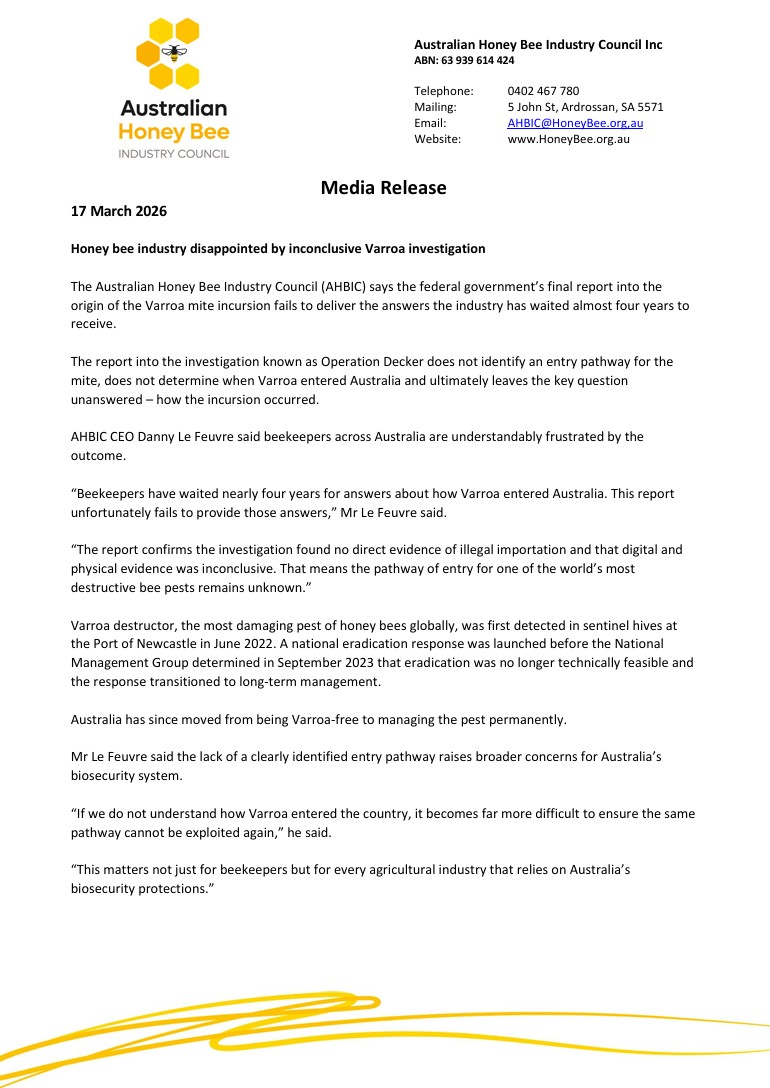
  • Media Release: Honey bee industry disappointed by inconclusive Varroa investigation

    CLICK HERE TO OPEN This MEDIA RELEASE AS A PDF

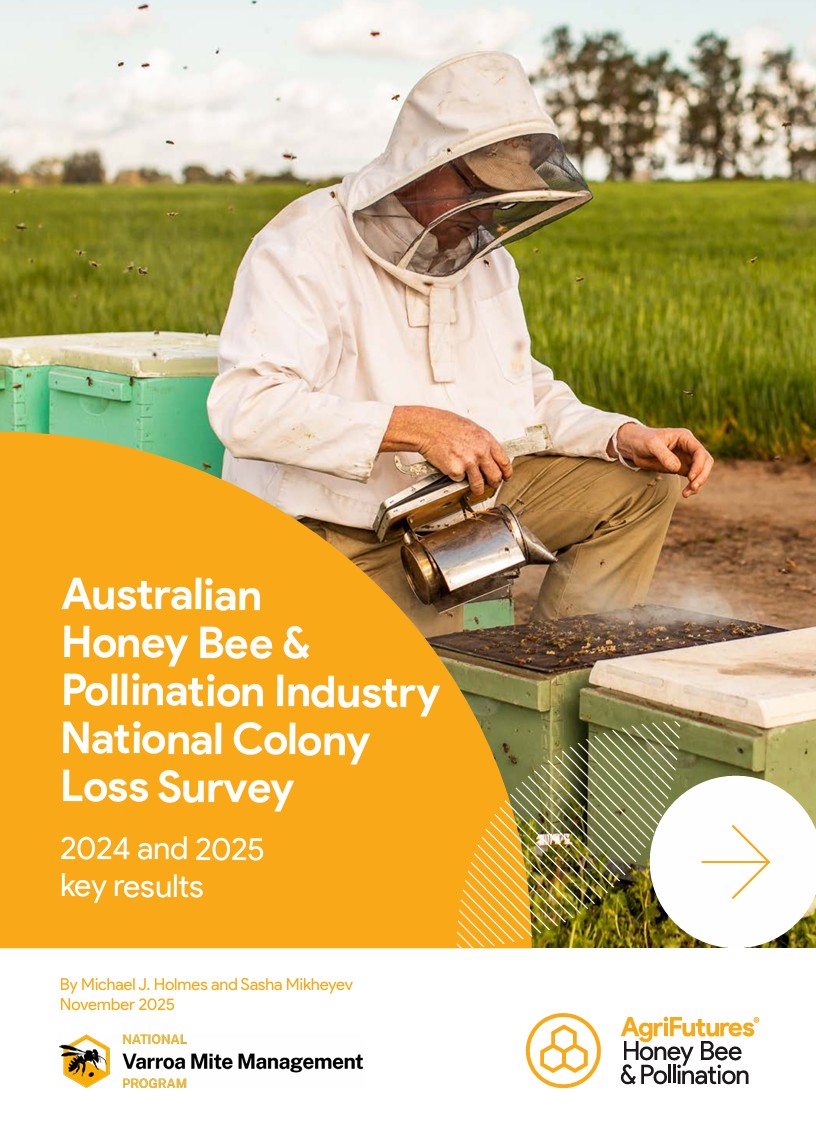
  • Australian Colony Loss Survey Results Report 2025

    Australian Colony Loss Survey Results Report 2025

    The Australian Colony Loss Survey 2025 results have published!

    Coloss Report 2025 Click Here


    The Australian Colony Loss Survey provides valuable hive management and hive health data for the beekeeping industry.

    The 2025 annual survey supported by funding through The National Varroa Mite Management Program, delivered by AHBIC and managed by AgriFutures Australia was conducted to collect national data and monitor changes in colony loss over time.

    This survey provides critical data to support and guide the Australian beekeeping industry as it navigates an increasingly complex set of challenges. Covering key issues such as Varroa mite management, queen health and failure, seasonal pressures, and broader biosecurity risks, the survey offers a comprehensive snapshot of current industry conditions.

    The 2025 report highlights the ongoing efforts of beekeepers across Australia to maintain colony health and sustain pollination services. The Australian Colony Loss Survey 2025 aims to strengthen industry resilience by providing evidence-based insights, supporting informed decision-making, and contributing to a sustainable future for Australian apiculture.


    Check out the Australian Colony Loss Website: https://colonyloss.au/

  • Australia’s National Bee Pest Blitz Campaign! is BACK!

    Bee Pest Blitz

    Bee Pest Blitz is a national initiative throughout April annually, it is a campaign to increase awareness of the importance of bee biosecurity and encourage beekeepers to inspect their hives for high priority exotic pests.

    This national month-long call-to-action campaign encourages beekeepers to conduct surveillance during the month of April. But beekeepers can and should check their hives regularly.

    The Bee Pest Blitz website beepestblitz.com.au is live and contains resources to assist beekeepers to conduct alcohol washes on their hives and report their findings.

    Bee Pest Blitz is a Department of Agriculture, Fisheries and Forestry (DAFF) funded initiative, led by the Australian Honey Bee Industry Council (AHBIC), Plant Health Australia (PHA), and supported by all state and territory governments.

    Bee Pest Blitz will be supported by Bee Biosecurity Officers (BBOs) in each state under the National Bee Biosecurity Program (NBBP), and engagement and networking with the National Bee Pest Surveillance Program (NBPSP).

    By participating in the Bee Pest Blitz month, Australian beekeepers will fulfil their bee biosecurity obligations and one of the three inspection requirements under the Australian Honey Bee Industry Biosecurity Code of Practice.

    Check out the video explaining how to alcohol wash your hives! Dive into your hives this April then record and report your findings, all details on the website.


  • Virus transmission put under the microscope to improve beekeepers’ access to oversees genetics

    Excerpt from AgriFutures “News and Events (18/03/2026)

    Experiments look to improve beekeepers’ ability to import desirable genetics, by understanding how deformed wing virus is transmitted from queen bees to eggs through drone semen.

    New insights into the transmission of a significant honey bee virus could pave the way for safer access to imported genetics that could help Australia’s honey bee and pollination industry adapt to varroa mite.

    Breeding varroa-resistant bees using imported genetics is one approach in the suite of promising methods to manage Varroa destructor. Genetics can be imported from overseas in the form of drone (male honey bee) semen or queen bees. Desirable genetics can improve honey production and influence a range of other attributes. However, ensuring the best-possible genetics are safe from damaging viruses is critical.

    Honey bee viruses, including deformed wing virus (DWV), can be transmitted to queens and their offspring through infected drone semen, which can devastate colonies. Fortunately, DWV has not been detected in Australia.

    Dr John Roberts of CSIRO, co-researcher Dr Jody Gerdts of Bee Scientifics and their collaborative team are working to understand the transmission process of DWV so that beekeepers can be confident in the use of imported beneficial genetics, such as drone semen.

    “DWV is common around the world. A challenge that our industry faces in trying to access overseas genetics is finding source material that is virus-free,” John explained.

    “This project is looking at ways we can reduce the risk of DWV from imported overseas genetics by better understanding the transmission process.”

    Getting on the front foot of varroa and viruses

    DWV is one of the most common honey bee viruses around the world and is primarily spread through varroa mite. The virus can impact all life stages of the honey bee but one of the main symptoms is wing deformities in adult bees, which is the most obvious indicator of the virus. DWV can also result in the mass death of bee colonies.

    Take a read of the full article here:

    VIRUS TRANSMISSION PUT UNDER THE MICROSCOPE – AgriFutures Australia


  • B-Qual Australia

    B-QUAL Australia Pty Limited has been established by the Australian Honey Bee Industry Council (AHBIC) as an independently developed and audited food safety program.

    B-Qual Mission:

    To accredit and adopt a QA (quality assurance) program for more than 90% production from the Australian honeybee industry. The project develops Certification and trains industry participants in QA standards and biosecurity; as well as providing ongoing third-party audit system.

    We encourage our readers to take a look at the BQual website

    B-Qual March Newsletter

    The B-Qual Newsletter articles from March 2026, with topic’s:

    • Queen Rearing Basics: Tips for Successful Queen Production

    • Maximising Honey Production: Seasonal Tips for Aussie Beekeepers

    • Beekeepers on high alert as bee-killing varroa mite spreads in South Australia
  • AHBIC Biosecurity Update – Resistant Varroa Mite – March 2026

    5th March 2026

    Pyrethroid Resistant Varroa Confirmed in QLD

    Queensland DPI have confirmed pyrethroid resistance in a population of mites in SE Queensland. This new confirmation in Queensland is linked to the Northern NSW pyrethroid resistant varroa case (AHBIC Biosecurity Update 11th February 2026). Further testing will continue across suspected apiaries to determine the extent of spread. At this stage the resistance in this QLD case does not appear to be as a result of hive movements from NSW to QLD.

    Determining Distribution

    NSW DPIRD and Queensland DPI  are working collaboratively on tracing hive movements and conducting further surveillance of any apiaries as necessary in both Northern NSW and southern QLD regions to better understand the distribution of the resistant mite population.

    At present, pyrethroid-resistant mite populations have not been reported and do not appear to be affecting beekeepers in southern NSW or Victoria. However, it is still important for all beekeepers to keep a close watch on this evolving situation.

    Background, Testing and Results

    In early February the NSWDPIRD confirmed the presence known resistance-conferring mutation that is resistant to the pyrethroid chemical group which includes Bayvarol and Apistan varroacides. The genetic mutations are known to occur in varroa mites in North America and also in parts of Europe and Eurasia.

    Resistance Information

    Resistance conferred by the L925I and L925M mutations, as have now been confirmed in these linked apiaries. The genetic resistance reported may have arisen via several pathways and AHBIC understands NSW DPIRD is undertaking further testing focussed on assessing the viruses that are present within the resistant mite populations. This may help industry better understand how these pyrethroid resistant mite populations have occurred.

    Importance of Best Practice

    It is critically important beekeepers undertake a best practice approach to varroa management. A key goal of integrated pest management is to reduce resistance to synthetic acaricides.

    We remind all beekeepers the key practical aspects to management of Varroa using integrated pest management includes:

    • Conducting regular hive inspections, including monitoring for varroa to determine mite load
    • Choosing appropriate treatment method
    • Rotating chemical modes of action for Varroa treatments
    • Following all permit/label instructions for treatment duration and dose
    • Monitoring post treatment to determine treatment efficacy
    • Keeping good apiary records

    If you think your treatment isn’t working or you see unusual mite or colony activity we urge you to contact your department:

    • NSW Beekeepers

    If you suspect treatment failure, please contact the NSW DPIRD Biosecurity Helpline on 1800 680 244 or complete the online form. NSW DPIRD experts will work with you to assess the situation.

    • QLD Beekeepers

    Contact an authorised officer via the Bee123 form, by calling 13 25 23 or emailing varroa@dpi.qld.gov.au. Staff from Biosecurity Queensland will provide advice on what to do.

    Taking Care of Yourself and your Mates

    We acknowledge that ongoing challenges facing our industry can be incredibly difficult to navigate. If you are having a really hard day, feeling overwhelmed, unsure where to start, are experiencing anxiety, depression or looking for ways to support a friend, we encourage you to reach out to available resources for support. Mental health, counselling and financial support are available from many services:

    Did you know?

    Beyond Blue have developed “NewAccess”, a tailored mental health coaching program for small business owners, available by phone or online from anywhere in Australia. “NewAccess” is a free, confidential mental health coaching program, designed to help small business owners and sole traders manage stress, worry and overwhelm. Enquire today online or call: 03 9250 8305


    Refer to the AHBIC Varroa Chemical Treatment Table for a quick guide to modes of action and better treatment understanding.


    CLICK HERE TO OPEN This Update IN PDF


    Bianca Giggins

    Industry Development Manager

    0402 467 780

    bianca@honeybee.org.au

    AHBIC, its employees, executive and consultants expressly disclaim all and any liability to any person in respect of anything, and the consequences of anything, done or omitted to be done in reliance, whether wholly, partly, upon the whole or any part of the contents of this industry update document.


  • Friends of AHBIC

    If you aren’t already a Friend of AHBIC, we welcome you to join our group of organisations and individuals who are supporting Australia’s national beekeeping industry that supports you.

    BECOME A FRIEND

    OUR CURRENT FRIENDS

  • 2027 Nuffield Scholarships are OPEN!

    To be considered for a 2027 scholarship, you apply in 2026. Research and travel start in 2027.

    Applications for 2027 opened on Monday 16 February 2026.

    All scholarships are available to Australian citizens or permanent residents only.

    Drought Resilience Scholarships

    In addition to our longstanding scholarship investors, the Future Drought Fund (FDF) are investing in at least five scholarships that are specifically available to study drought resilience and support innovation. These scholarships will support applicants to build drought resilience expertise, adapt innovative technology and practices from overseas and share these learnings to advance Australian agriculture.

    Other study topic ideas relating to specific industry sectors are listed under the “Available Scholarships” page.

    Please review these pages on this website prior to applying:

    Eligibility
    • Typically between 28-45 years of age. Please note that exceptional candidates outside this age range will be considered
    • A citizen or permanent resident of Australia
    • Engaged in farming, horticulture, fishing or associated industries
    • Intending to remain involved in food and fibre industries in Australia
    Value
    • $40,000 bursary, subject to guidelines set out on this website to cover costs associated with the study and reporting
    • $3,000 of the bursary will be withheld as an assurance on the submission of an approved report
    • Likely costs exceeding the bursary value must be met by the scholar
    Program Components
    • Nuffield Australia National Conference is a chance to engage with the Nuffield network and agribusiness leaders, receive a program briefing and be announced as part of the latest intake. Held in September annually, successful applicants will attend the two-day conference and 1.5 day regional tour.
    • Contemporary Scholars Conference (CSC). Held in March annually, the CSC is a one-week program for all newly-selected scholars from around the world. Scholars build networks, and consider international trade and policy issues. Scholars share and learn about different cultures, represent their country and industry, and enhance leadership skills.
    • Australian Focus Program (AFP) is a 1-2 week program which commences in Canberra with workshops and seminars to understand parliament, advocacy, policy, megatrends and key Australian agriculture issues. Scholars enhance their industry knowledge and visit a number of farms, agribusinesses and research facilities. There is also be a strong focus on drought resilience and sustainability in this part of the component.
    • Global Focus Program (GFP) offers a five-week, group travel experience spent in various countries across the world. Scholars select one GFP and investigate agricultural marketing, trade, environmental issues and experience social and cultural aspects of each region. Drought resilience research also forms part of the GFP programs.
    • Individual Study enables scholars to travel to countries of choice to study their chosen topic. This component is four/five weeks which doesn’t have to be concurrent travel.
    • Written and Verbal Reporting is a requirement of the scholarship and these are completed following the research. Reports are due in writing as well as online at virtual events and in person at the National Conference.

    LEARN MORE HERE

    Scholarship Benefits

    • 15-weeks of purposeful learning and unique access to our approachable, global agricultural network
    • Connections with the global alumni – over 500 scholars in Australia and 2,000 worldwide
    • See leading and innovative businesses and identify new best practices
    • Select a research topic that will be of use to you, your business, community and industry

    The Nuffield program opens doors to exciting and rewarding experiences. Whether it’s walking the halls of Westminster or Washington DC, or touring a leading wheat and maize research facility in Mexico, a scholarship presents a career defining opportunity.

    As a Scholar you will:

    • Research a topic to add value to the Australian primary industry sector
    • Join a global network of 2,000 scholars, who have enjoyed this unique experience
    • Become a lifelong member of Nuffield to promote primary industries
    • Travel overseas and have access to international businesses and individuals not otherwise reachable

    Nuffield Scholars have achieved distinction in many fields. Proof of both the calibre of those selected and the effect and value of the scholarships are such that many have gone on to an extraordinary range of positions. Scholars have become Federal and State politicians, chairs and members of national and regional commodity boards. Many have made a significant impact at a regional and local level, both in community affairs and in farm management. Others have developed careers as advisers and managers both in Australia and overseas.

    In every case scholars attribute a proportion of the responsibility for their later career success to the scholarship and continuing friendships and associations that follow. The learning process continues for life.