Honey Bee
← Back

Newsletter Edition - April 2026

  • Chair Report – April 2026

    Chair Quarterly Report April 2026

    Recently I attended an event where I listened to the CEO of Sunrice speak. I was intrigued by his sentiment that Australian primary produces are some of the toughest, most resilient in the world. Not only do we operate in such a harsh variable climate, but we are not subsidised by our government like many of our competitors internationally due to Australia’s free trade stance. Yes, Australian beekeepers are tough and resilient, we’ve got this!

    Resistant Varroa, A New Incursion

    It is extremely upsetting to learn that Australia has identified resistance genes in both Pyrethroid; L925l/L925M (Bayvarol and Apistan), and Amitraz; Y215H (Apivar and Amitraz).

    Disturbingly, it has been announced that the resistant mite is a new incursion. NSW DPIRD have determined the AMR1 virus associated with new varroa points to it being most similar to samples from North America and Belgium as the origin. Fortunately, no new viruses have been identified, once again, we may have dodged the deformed wing virus bullet.

    NSW DPIRD and QLD DPI are conducting further tracing with all reports of the resistant variant being connected. At present the resistance has been identified in southern Queensland and across NSW, with tracing identifying the mites is SA with the first detection but not considered established in SA at this stage.

    Once again, AHBIC has been communicating with the investigators and government to identify the pathway of entry. It simply is not acceptable that not one but now two separate mites have entered our shores without a definitive pathway. If you know of any suspicious activity, no matter how small, please contact AHBIC or REDLINE.

    Our thoughts are with those operators that have learnt that they have the new variant of the mites the hard way, losing entire apiaries in some cases.

    What does this mean for Australian beekeepers?

    The mite from the 2022 incursion was tested and proven to not have resistant markers. This meant that with correct practices, beekeepers would have had both Pyrethroid and Amitraz usage without significant failure for years, if not decades to come.

    Now with resistance to the said chemical classes, the playbook for successful mite management has a new chapter. Does this mean that Pyrethroids and Amitraz simply won’t work anymore? NO. However, if pyrethroids and Amitraz are the only treatments being used then you are actively selecting for the resistant mites.

    The key message from AHBIC:

    1. Control your own backyard. Internationally we see ‘pockets’ of resistance, BUT, we also see the use of synthetics successfully with correct practices, particularly with Amitraz.
    2. Non synthetic treatments such as Formic, Oxalic and Thymol are your friends. Using these regularly, including pre and post synthetic use are killing the resistant mite population which will increase the efficacy of your synthetic treatment.
    3. Check, Check, Check! Monitoring is your mate.

    For further details on identifying and managing resistant mites, please see AHBIC’s fact sheet on resistance (IN THIS EDITION)

    AgriFutures

    AHBIC is committed to further develop and foster the relationship between the honeybee industry and AgriFutures. It is extremely important for AHBIC to ensure that AgriFutures deeply understand the challenges and needs of our industry.

    Over the past months, AHBIC have had several engagements with the AgriFutures staff. Amanda Olthof the Senior Manager of Levied Industries and Luke Evans the Program Manager for the Honeybee and Pollination Program came to our AHBIC executive meeting to discuss issues and learn how we can build a stronger relationship. Luke Evans also came to visit me at our base. Luke explained that the visit was very important for him to see in person how a commercial bee operation works. He will now have a greater understanding of beekeeping.
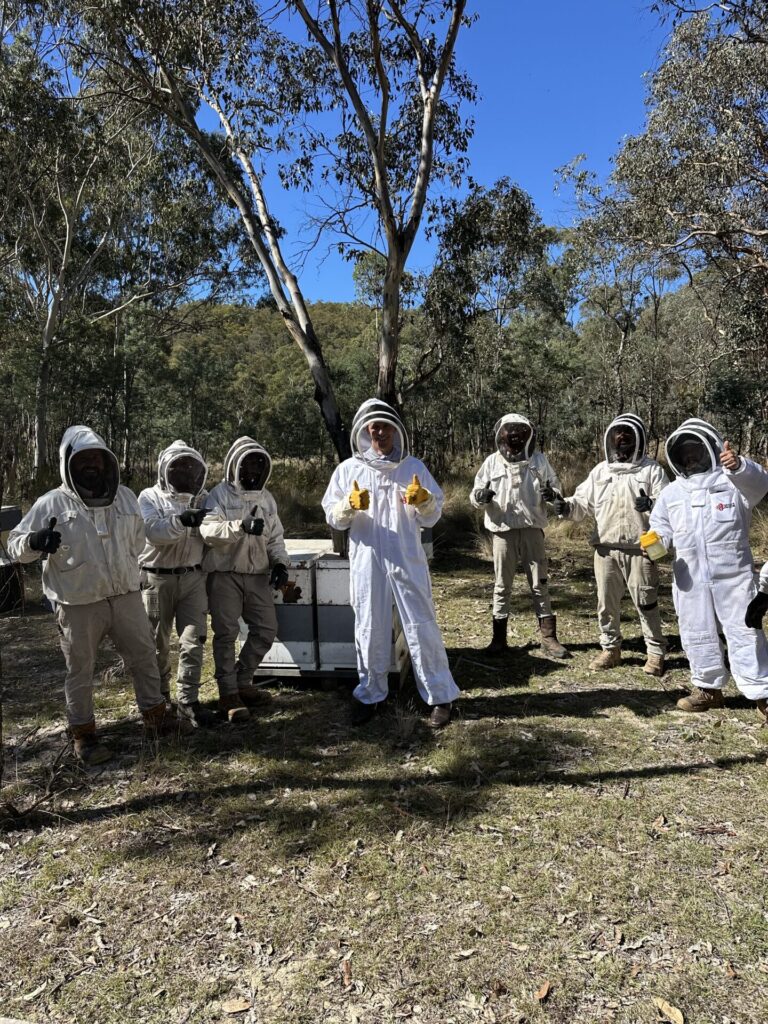
    Thumbs Up! A brave Luke Evans, AgriFutures Program Manager Honey Bees, in the apiary alongside staff from Goldfield Honey, Vittoria in a recent visit and catch up with Jon Lockwood.

    In March, Mick Vetch, the new Chair of AgriFutures called to visit me at our premises. It was great to sit down with Mick and discuss the dynamics of our industry and give him greater context as to our industry’s needs. Mick was involved with our industry in the past when he sat as the NSW Shadow Agriculture Minister. It’s great to have someone with prior knowledge and understanding in the role.

    There are four positions coming up to sit on the Honeybee and Pollination advisory panel in the next 12 months. Please take a look at the AgriFutures website, and keep this in mind for yourself or someone that may be suitable: Advisory Panel Recruitment | AgriFutures Australia

    Honey and Pollination

    Honey production has remained average over the past quarter nationally. Stockpiles in beekeepers and packers sheds are diminishing. Recently we have seen the price slowly start to creep up, however this is not enough to provide beekeepers financial sustainability. Diesel prices have had a significant effect on running costs. Thankfully over that last week prices have come down to a more realistic figure. Looking forward, it is predicted that much of the country will experience a dry winter and spring which will impact next season’s production immensely.

    AHBIC patiently wait for DAFF to unpack the findings of the recent imported honey survey, this is extremely frustrating, but nothing happens fast in this area.

    Almond contracts and prices are currently being negotiated. Brokers, growers and beekeepers are becoming nervous as many reports are coming through that Varroa is significantly impacting hive health. Almond growers in some regions are reporting a tough harvest as many received unwanted rain in January. The horticulture industry are important partners of the bee industry, and we need to navigate the tough times together.

    Jon Lockwood

    Chair


  • CEO Update April 2026

    CEO Report April 2026

    Just as we almost start to get used to the new world with varroa, along comes resistance. Another devastating game changer for the industry. As we head into conference season, I am sure beekeepers will be soaking up all the information from the expert presenters around managing resistant mites. As we have said in many of our communication the basic principles still remain the same. Rotate your modes of action and monitor your mite numbers.

    APVMA and product registrations

    There has been commentary in industry around the APVMA process and what role AHBIC plays. I have provided a brief explanation on AHBIC’s role for both emergency permits and full registrations in a separate newsletter article in this edition.

    There has also been some commentary around the recent Canadian oxalic acid strip registration supported by the Canadian honey council and comparisons to NZ own use permit system and again AHBIC’s role. The Canadian registration system is very different to Australia.  They can register active ingredients by providing shared a common data set. Multiple labels/products can then leverage that common data set to expedite the process. This does not allow for the use of generic products as some are suggesting. Only products registered with the PMRA (Canada’s version of the APVMA) can be used, which in that aspect is similar to the Australian system. The devil is always in the detail.

    Alternative varroa treatments

    AHBIC continues to meet with manufactures searching for new products and encouraging them to expand to our market. We also work with our RDC’s in Hort Innovation and AgriFutures to ensure research is occurring to find new solutions. We sit on many steering committees to ensure the outcomes of the research is practical and useful for beekeepers. Some of the work that is underway includes;

    • Fungal bio-control through Macquarie University
    • RNAi interference technology with multiple projects and some startups progressing this technology in Australia. This is the same technology as Norroa (Canadian based RNAi product)
    • Projects by Southern Cross University (Dr. Cooper Schouten) and NSW DPIRD to assess and compare treatments and efficacy including off-label work
    • Macquarie Uni (Dr. Theotime Colin) developing non-chemical control methods of mite management
    • Australian Queen Bee Breeding Association national varroa mite breeding strategy to select for varroa tolerance.

    Operation Decker – Federal Investigation into Varroa

    AHBIC has lobbied DAFF to re-initiate the investigation in light of, what is now confirmed, a new varroa incursion. We continue to provide information where we can, along with NSW DPIRD. We have not had any confirmation from DAFF that they will re-open the investigation as yet. Anyone who has information around either of these two incursions can anonymously report by calling Red Line on 1800 803 or via their website: https://www.agriculture.gov.au/biosecurity-trade/policy/legislation/compliance/redline.

    Imported Honey

    We continue to work with DAFF who now have the testing results from the national imported honey survey. DAF is working with participating jurisdictions on next steps.  This is a positive outlook with DAFF recognising the seriousness of the issue and commitment to finding solutions.

    Red Dwarf Honey Bee Incursion – Burrup Peninsula WA

    The most recent situational update from the WA DPIRD team has again reported no further detections of foraging red dwarf honey bees in the quarantine zone. This is very encouraging with no new detection since July 2025. The proof of freedom surveillance will continue through to the end of 2026 and with no new detections proof of freedom will be achieved.

    Biosecurity preparedness work

    We are pleased that AgriFutures has funded the development and updating of our key industry biosecurity preparedness documents. These include the biosecurity plan and several high priority pest contingency plans, including tropilaelaps mites. These documents provide the foundation for any future responses with the current versions outdated or missing, so this project will significantly strengthen our preparedness as an industry. Industry consultation is a feature or the project, and beekeepers will have the opportunity for input.

    The Month Ahead

    Conference season starts in the coming weeks with NSW in Bathurst being the first. AHBIC will have a presence at all state conferences culminating with the Tasmanian conference in Launceston early July along with the AHBIC AGM.

    We continue to participate in the fuel crisis meetings, food security discussions and continue overseeing the Plant Health Australia managed biosecurity programs. The Plant Health Australia AGM and deed meetings are in Adelaide this May. This will include a deed review meeting where AHBIC will feed in the lessons from the varroa response.

    Danny LeFeurve

    CEO

  • Miticide Registrations, APVMA and the Role of AHBIC

    There has been commentary across industry about the APVMA process for varroa miticides and what role AHBIC plays. It is important to separate three things: emergency permits, full product registrations, and AHBIC’s advocacy role.

    Emergency permits 

    Emergency permits are temporary approvals used to legalise the use of an agvet chemical product, or active constituent, to address an emergency situation. The APVMA states that the final decision on whether a use qualifies as an emergency use rests with the APVMA, but they often not approve multiple permits for the same active ingredient or where alternatives exist. 

    Anyone can apply for an emergency permit, but applications are usually led by a state jurisdiction or sometimes industry bodies. In the varroa response, many treatment permits have been held by NSW DPIRD because of its role as the lead agency. AHBIC also holds permits where appropriate, such as for copper naphthenate but does not hold any varroa treatment permits. 

    Emergency permits are assessed against APVMA criteria and are generally conservative. The APVMA must be satisfied there is adequate information to manage risks to users, bees, the environment and trade. Where there is inadequate scientific data provided the permit will reflect limitations on use. 

    AHBIC has strongly advocated for access to emergency treatment options, but AHBIC does not determine or has input into permit labels, withholding periods, treatment limits or other conditions. Those decisions sit with the APVMA. 

    Full product registration 

    Full registration is a separate and more detailed process. Before an agvet chemical product can be legally supplied, sold or used in Australia, it must be registered by the APVMA.  

    For a product registration, the manufacturer or its Australian representative submits the application with a proposed label and supporting scientific data. The APVMA must be satisfied that the product meets safety, efficacy, trade and labelling criteria.  

    This means label claims must be backed by evidence. For example, if a manufacturer wants a label to allow multiple treatments in a season, the data must support safety, efficacy, residues and resistance management. If the evidence is limited, the label will be conservative. 

    AHBIC has no role in assessing or providing input into full registrations. That process is confidential and between the applicant and the APVMA. Once a product is registered, any label change or variations must also be submitted by the manufacturer (not AHBIC) with supporting data. Lobbying AHBIC or the APVMA will not, by itself, change a registered label it is the manufacturer that must be convinced to propose changes. 

    The issue of influence and industry capture 

    The APVMA has also been the subject of significant scrutiny. A key review published in July 2023 by Clayton Utz commissioned by the government addressed serious allegations raised through Senate Estimates about industry influence. Whilst the report found there had been no evidence of inappropriately registered products it did identify a perception risk. It noted the regulator’s strong focus on approval timeframes and its level of engagement with industry stakeholders. 

    Importantly the report highlighted the structural reality of the system, in that, while industry, including AHBIC, can advocate for access to tools and highlight operational impacts, it cannot influence regulatory outcomes, data assessments or label settings.  

    Product registrations, label claims and use patterns are determined solely through APVMA’s statutory, evidence-based assessment process, and any changes require formal applications supported by data from the product registrant.  

    In practical terms, this means AHBIC cannot “get a label changed” or alter use conditions through advocacy—its role is limited to facilitating industry need, encouraging investment, and supporting the generation of the evidence required for regulatory consideration. 

    For AHBIC, this is an important distinction. Industry should advocate for access to safe and effective tools, but it should not seek to influence scientific regulatory decisions. AHBIC’s role is to identify industry need, communicate practical impacts, encourage manufacturers to enter the Australian market, and support R&D that builds the evidence base required for registrations. 

    What AHBIC does 

    AHBIC’s role is advocacy, coordination and intelligence gathering. This includes: 

    • Encouraging manufacturers to register products in Australia. 
    • Over the last 4 years AHBIC has met with every manufacturer that has registered varroa treatments globally.  Many of the current options available to beekeepers is a direct result of our advocacy. 
    • Advocating for emergency access where identified gaps exist. 
    • AHBIC has lobbied NSW DPIRD and APVMA to allow multiple emergency permits which normally doesn’t occur. We have searched globally and identified options that are registered elsewhere and advocated for those to be available for Australian beekeepers. As an example the whole AHBIC executive has met with directors of the APVMA in 2024 to discuss a range of issues (see AHBIC – APVMA communique) including access to ‘own use’ permits and greater access to oxalic acid. 
    • Working with R&D providers on new treatment options. 
    • Working with AgriFutures, Hort Innovations and universities to identify emerging control options and what work needs to be done in Australia to bring them to market. Some of these currently being developed include fungal control, RNAi control, screening of other agricultural miticides to find new effective varroa controls and the development of new actives/modes of action. 
    • Monitoring global miticide developments and resistance issues.  
    • Communicating practical information to beekeepers. 
    • Working with suppliers to assist with bottle necks or regulatory barriers to supply. 

    This aligns with AHBIC’s strategic role as the national voice for the honey bee and pollination industries, particularly in biosecurity, market integrity and industry resilience. 

    Final message 

    The miticide registration system is evidence-based, confidential and regulator-led. AHBIC can advocate for access and help build the case for industry need, but it cannot write labels, approve products or override APVMA decisions. 

    That independence matters. The industry needs timely access to effective varroa treatments, but it also needs confidence that products are safe for bees, beekeepers, consumers, trade and the environment. 

    Article written by: Danny LeFeuvre, CEO Australian Honey Bee Industry Council, 2026

  • AHBIC Biosecurity Update – Varroa Synthetic Chemical Resistance Management

    29th April 2026

    What We Know

    Varroa synthetic chemical resistance detections have been laboratory confirmed and considered established broadly across NSW and southern QLD. It is no longer considered geographically confined with reports of treatment issues being confirmed across large areas.
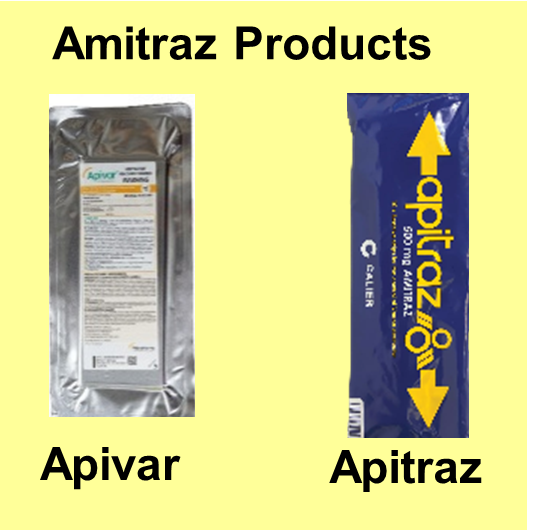
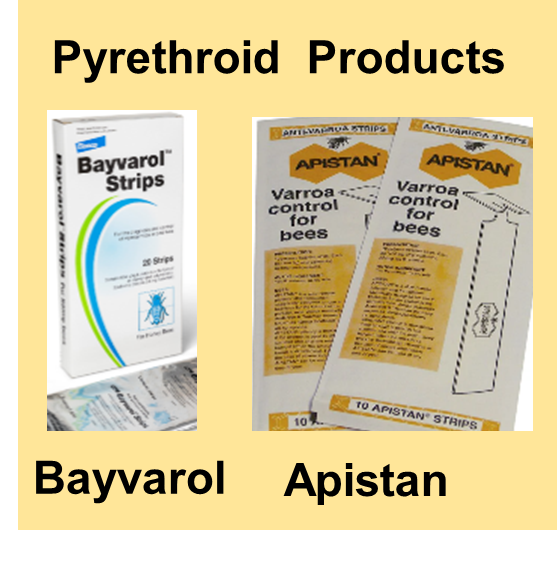
    Beekeepers are experiencing reduced or even complete failure of treatments due to populations of Varroa destructor having resistance to synthetic pyrethroids and amitraz products this affects Bayvarol, Apistan, Apivar and Apitraz branded products, pictured.

    Important: If you suspect you might have resistance or are in an area that has known resistant populations you should not use synthetic miticides until your resistance status is formally identified.

    Key Priorities for Beekeepers

    To minimise the risk of treatment failure and colony death, beekeepers must:

    • ROTATE between modes of action.
    • MONITOR treatment performance.
    • Implement Integrated Pest Management (IPM) strategies utilising all treatment options both chemical, mechanical and cultural in every management strategy.


    Economic Thresholds – Can be Adapted

    The current thresholds are a good guide for beekeepers to adopt. However, they are not fixed or legislated nor stipulated on product labels. It’s up to individual beekeepers and their risk appetite and situation to determine mite thresholds.

    Where there is resistance, beekeepers are reporting they are struggling to reduce high mite numbers with acids alone, so re-evaluating thresholds can help in ensuring you maintain low mite counts in the short term.

    If you know or suspect you might have resistance, it’s important to consider lowering your mite threshold to ensure low mite counts can be maintained. Beekeepers need to plan for emergency situations when treatment failure is detected to prevent mite run away in hives.

    Monitor Chemical Treatment Performance

    By knowing your mite levels, you can determine not only when to treat but also whether your treatment is working.

    Pre-treatment

    • Alcohol wash hives immediately prior to treatment to establish a baseline.
    • The more hives you wash the better but at least 10% per apiary.
    • Record individual hive mite counts (i.e. note wash result on lids) averaging is also ok but not as accurate.

    Mid-treatment

    • Alcohol wash hives mid-treatment time, i.e. at weeks 3-4 (Pyrethroid) and 5-6(Amitraz), to establish early confirmation of efficacy or potential failure.
    • Keep the method consistent.
    • You MUST monitor the same hives in the apiary each time. This will allow a clear comparison to assess treatment efficacy.
    • If mite counts are the same or slightly lower than baseline there is no cause for immediate concern, but it is important to follow up with post treatment monitoring.
    • If mite counts are significantly more than the pre-treatment/baseline in any hive, this is cause for concern and we recommend:
      1. Immediately remove the synthetic treatment, use an organic acid treatment to knock down phoretic mite numbers, immediately continue with next treatment in IPM strategy.
      2. Contact your state department apiary team.
      3. Collect mite samples arrange further testing immediately.

    Post-treatment

    • Alcohol wash hives at treatment removal, not a week after treatment removal, again following the same procedure as pre and mid treatment.
    • If mite counts are the same or more than the baseline mite numbers you need to take action
      1. Consider following up with an urgent organic acid treatment to knock down phoretic mite numbers as quickly as possible.
      2. Immediately continue with next treatment in IPM strategy to ensure colony survival.
      3. Contact your state department apiary team.
      4. Collect mite samples and arrange further testing immediately.

    Further Information

    It is never too early to test for resistance, be proactive to ensure colony survival.

    AHBIC has been advocating for alternative testing options for determining resistance status in your hives that offers both economical and rapid commercial testing for resistance.

    If you suspect resistance and are interested in testing, keep the contents of your mite wash. Notify the supplier of your treatment about suspected resistance. Testing will soon be available through “D-central” contact them via their website D-central or email: info@d-central.au


    CLICK HERE TO OPEN This Update IN PDF


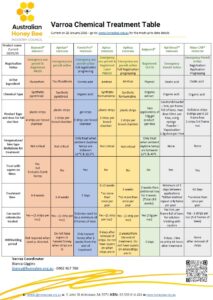
    Refer to the AHBIC Varroa Chemical Treatment Table for a quick guide to modes of action and better treatment understanding.


    Bianca Giggins

    Industry Development Manager

    0402 467 780

    bianca@honeybee.org.au

    AHBIC, its employees, executive and consultants expressly disclaim all and any liability to any person in respect of anything, and the consequences of anything, done or omitted to be done in reliance, whether wholly, partly, upon the whole or any part of the contents of this industry update document.


  • AHBIC Biosecurity Update – Incursion of Resistant Varroa Mite – 23 April 2026

    23rd April 2026

    Second Varroa Mite Incursion Confirmed

    NSW DPIRD have confirmed that the resistant mite populations detected in QLD and NSW are a new population of mites un-related to the original 2022 detection. This new population of mites has confirmed genetic resistance to both pyrethroid and amitraz-based treatments. Further work is being undertaken to determine how these mites arrived in Australia and how far they have spread.

    So far, the hives tested have not shown presence of any new exotic viruses. However, further genetic analysis of the endemic virus AR1 (aka rhabdovirus) found with these mites, confirms it is an exotic strain and different in origin to the existing endemic AR1 virus associated with the Newcastle original population.

    The Consultative Committee on Emergency Plant Pests (CCEPP), drawing on NSW DPIRD tracing and laboratory testing, has verified that this resistant population is present across Queensland and New South Wales. Tracing and subsequent lab testing has also identified that the first mites detected in South Australia’s Riverland to be part of the new population but is not considered to be established.

    The CCEPP members agreed that the new incursion of resistant mite populations cannot be eradicated due to a lack of containment and the unknown entry pathway.

    Resistant Mites will Spread

    Resistant mites appear to be spreading through the trade and movement of live bees and colonies as well as proximity to affected apiaries in both NSW and QLD. The resistance has been recorded across NSW and southern QLD, additional areas are likely to be impacted.

    These miticide resistant varroa mites will eventually become widespread, meaning beekeepers will eventually have lower efficacy from key synthetic control tools, and there will become an increased risk of high mite loads and colony losses across Australia.

    The messaging remains consistent from the start of the incursion, it is more important than ever to  ROTATE modes of action, and MONITOR mite numbers before, during and after miticide treatments. If you suspect that pyrethroid or amitraz resistance-carrying mites are in your apiaries or in your area, you should not use amitraz or pyrethroid products where possible. Instead use organic acid-based products as there is no known resistance.

    If you are already treating with synthetics and suspect resistance, then act swiftly to test your colonies via state Bee Biosecurity Officer assistance or privatised testing facilities. Confirmed synthetic treatment failures will require changing management practices including integrated pest management and using only organically derived treatments to give your colonies the best chance of survival.

    Taking Care of Yourself and your Mates

    We acknowledge that these ongoing challenges for our industry can be incredibly difficult to navigate. We encourage you to reach out to available resources for professional support if you feel you need it.


    CLICK HERE TO OPEN This Update IN PDF


    Refer to the AHBIC Varroa Chemical Treatment Table for a quick guide to modes of action and better treatment understanding.


    Bianca Giggins

    Industry Development Manager

    0402 467 780

    bianca@honeybee.org.au

    AHBIC, its employees, executive and consultants expressly disclaim all and any liability to any person in respect of anything, and the consequences of anything, done or omitted to be done in reliance, whether wholly, partly, upon the whole or any part of the contents of this industry update document.


  • 2026 Honeybee Industry Conference Bursary Opportunity!

    Through support from AgriFutures Australia capacity building grants, AHBIC invites applications to the 2026 Honeybee Industry Conference Bursary Opportunity.


    We are looking to award 4 beekeepers and 4 researchers the chance to receive up to $1,000 bursary to attend a 2026 State Beekeeping Conference.

    We want emerging beekeepers and researchers — especially those who wouldn’t be able to attend without financial help. To be eligible, applicants should be:

    • In the early stages of their career with 2-5yrs of experience in the beekeeping or related industry
    • Have practical experience with or a passion for European honey bees and
    • A passion to remain part of the industry as their career progresses.

    This bursary serves as a gateway for individuals to establish a solid foundation in the honey bee industry.Applications close Wednesday 6th May 5pm AEST ! So get in quick. For any queries or concerns, please contact:Bianca Giggins

    Industry Development Manager

    bianca@honeybee.org.au


  • Friends of AHBIC

    If you aren’t already a Friend of AHBIC, we welcome you to join our group of organisations and individuals who are supporting Australia’s national beekeeping industry that supports you.

    BECOME A FRIEND

    OUR CURRENT FRIENDS

  • AgriFutures Honeybee & Pollination Panel; Commercial Honey Producers and Researchers Wanted

    Applications now open for AgriFutures Honey Bee & Pollination Program Advisory Panel

    The AgriFutures Honey Bee & Pollination Program is seeking to appoint four new members to the Honey Bee & Pollination Advisory Panel.

    These positions are open to commercial honey producers, commercial pollinators and researchers working in honey bee or related fields, who are not currently engaged in AgriFutures Honey Bee & Pollination Program-funded research.

    Applicants should demonstrate:

    • industry experience and a desire to contribute to the industry
    • understanding of industry research priorities
    • strategic leadership and governance capability
    • ability to contribute effectively to the Advisory Panel.

    Applicants with experience in research and development management, extension or training are also encouraged to apply. Governance and financial management experience will be highly regarded.

    About the AgriFutures Honey Bee and Pollination Program

    The AgriFutures Honey Bee and Pollination Program invests in research that ensures a productive, sustainable and profitable beekeeping industry and secures the pollination of Australia’s horticultural and agricultural crops. The Program focuses on supporting the longevity of the honey bee and pollination industry in Australia with four priority areas:

    • Improve hive productivity with innovative pest and disease control, feeding, breeding, and automation solutions
    • Improve pollination, floral resource access and industry sustainability
    • Enhance industry capability
    • Deliver quality Australian honey with well characterised attributes and traceability.
    About the Advisory Panel

    The Advisory Panel brings together a diverse mix of leading commercial beekeepers, pollination service providers, researchers and industry advisors, offering deep expertise across honey bee genetics, health, nutrition, pollination, commercial production and applied research to support informed decision‑making for the program.

    The Advisory Panel provides recommendations on the allocation of RD&E funding for the AgriFutures Honey Bee and Pollination Program.

    AgriFutures Australia aims to maintain geographical, age and gender diversity to ensure that the Advisory Panel appropriately represents the Honey Bee and Pollination industry.

    Advisory Panel member roles & responsibilities

    The core functions of AgriFutures Industry Advisory Panels are to ensure that RD&E investment remains industry-demand driven, including:

    • Advising – providing advice on the industry requirements for investment through the development and monitoring of Strategic RD&E Plans
    • Identifying – providing recommendations to AgriFutures on suitable RD&E opportunities and activities to address industry issues
    • Aligning – providing feedback and investment advice on RD&E proposals submitted to AgriFutures to ensure investment is aligned to priorities in the respective Program’s Strategic RD&E Plan
    • Awareness –advising and assisting in the dissemination, adoption and commercialisation of RD&E activities.

    Activities of the Program are funded by industry levy and Commonwealth funds, and any funds contributed from third parties. Advisory Panel members are recompensed for their services to AgriFutures Australia at rates determined by the Commonwealth’s Remuneration Tribunal.

    Panel members may be required for up to 25 days per year and some travel is necessary.

    Selection criteria:

    • Industry experience and desire to contribute to the industry
    • Understanding of industry research priorities
    • Strategic leadership and governance skills
    • Ability to contribute to AgriFutures Honey Bee and Pollination Advisory Panel


    Prospective applicants should carefully consider the time commitment required to effectively contribute as an Advisory Panel member prior to submitting an application.

    This is a valuable opportunity for the next generation of industry leaders to play an active role in shaping the future of the Australian honey bee and pollination sector.

    To support continuity of knowledge and ensure a diversity of skills and perspectives, appointments will be staggered between August 2026 and November 2026. Successful applicants may also be invited to attend an Advisory Panel meeting as an observer prior to their official commencement.

    For more information please refer to the Honey Bee & Pollination Program Advisory Panel Selection Criteria.

    How to Apply:

    Applicants must complete the application form and skills matrix, and attach a CV (maximum three pages) via the online application system. As part of the application, applicants will need to outline their relevant experience in the Australian agricultural sector and their expected contribution to the Advisory Panel. Applicants should consider the time commitment required to contribute effectively before applying.

    Applications close 12pm (AEST) on Monday 20 July 2026.

    To support continuity of knowledge and diversity of skills and perspectives, appointments will be staggered between August 2026 and November 2026.

    Apply for the AgriFutures Honey Bee & Pollination Advisory Panel

    For any questions regarding the AgriFutures Honey Bee & Pollination Advisory Panel recruitment please contact:

    Luke Evans
    Program Manager, Levied Industries
    luke.evans@agrifutures.com.au


  • 2027 Nuffield Scholarships are OPEN!

    To be considered for a 2027 scholarship, you apply in 2026. Research and travel start in 2027.

    Applications for 2027 opened on Monday 16 February 2026.

    All scholarships are available to Australian citizens or permanent residents only.

    Drought Resilience Scholarships

    In addition to our longstanding scholarship investors, the Future Drought Fund (FDF) are investing in at least five scholarships that are specifically available to study drought resilience and support innovation. These scholarships will support applicants to build drought resilience expertise, adapt innovative technology and practices from overseas and share these learnings to advance Australian agriculture.

    Other study topic ideas relating to specific industry sectors are listed under the “Available Scholarships” page.

    Please review these pages on this website prior to applying:

    Eligibility
    • Typically between 28-45 years of age. Please note that exceptional candidates outside this age range will be considered
    • A citizen or permanent resident of Australia
    • Engaged in farming, horticulture, fishing or associated industries
    • Intending to remain involved in food and fibre industries in Australia
    Value
    • $40,000 bursary, subject to guidelines set out on this website to cover costs associated with the study and reporting
    • $3,000 of the bursary will be withheld as an assurance on the submission of an approved report
    • Likely costs exceeding the bursary value must be met by the scholar
    Program Components
    • Nuffield Australia National Conference is a chance to engage with the Nuffield network and agribusiness leaders, receive a program briefing and be announced as part of the latest intake. Held in September annually, successful applicants will attend the two-day conference and 1.5 day regional tour.
    • Contemporary Scholars Conference (CSC). Held in March annually, the CSC is a one-week program for all newly-selected scholars from around the world. Scholars build networks, and consider international trade and policy issues. Scholars share and learn about different cultures, represent their country and industry, and enhance leadership skills.
    • Australian Focus Program (AFP) is a 1-2 week program which commences in Canberra with workshops and seminars to understand parliament, advocacy, policy, megatrends and key Australian agriculture issues. Scholars enhance their industry knowledge and visit a number of farms, agribusinesses and research facilities. There is also be a strong focus on drought resilience and sustainability in this part of the component.
    • Global Focus Program (GFP) offers a five-week, group travel experience spent in various countries across the world. Scholars select one GFP and investigate agricultural marketing, trade, environmental issues and experience social and cultural aspects of each region. Drought resilience research also forms part of the GFP programs.
    • Individual Study enables scholars to travel to countries of choice to study their chosen topic. This component is four/five weeks which doesn’t have to be concurrent travel.
    • Written and Verbal Reporting is a requirement of the scholarship and these are completed following the research. Reports are due in writing as well as online at virtual events and in person at the National Conference.

    LEARN MORE HERE

    Scholarship Benefits

    • 15-weeks of purposeful learning and unique access to our approachable, global agricultural network
    • Connections with the global alumni – over 500 scholars in Australia and 2,000 worldwide
    • See leading and innovative businesses and identify new best practices
    • Select a research topic that will be of use to you, your business, community and industry

    The Nuffield program opens doors to exciting and rewarding experiences. Whether it’s walking the halls of Westminster or Washington DC, or touring a leading wheat and maize research facility in Mexico, a scholarship presents a career defining opportunity.

    As a Scholar you will:

    • Research a topic to add value to the Australian primary industry sector
    • Join a global network of 2,000 scholars, who have enjoyed this unique experience
    • Become a lifelong member of Nuffield to promote primary industries
    • Travel overseas and have access to international businesses and individuals not otherwise reachable

    Nuffield Scholars have achieved distinction in many fields. Proof of both the calibre of those selected and the effect and value of the scholarships are such that many have gone on to an extraordinary range of positions. Scholars have become Federal and State politicians, chairs and members of national and regional commodity boards. Many have made a significant impact at a regional and local level, both in community affairs and in farm management. Others have developed careers as advisers and managers both in Australia and overseas.

    In every case scholars attribute a proportion of the responsibility for their later career success to the scholarship and continuing friendships and associations that follow. The learning process continues for life.

  • B-QUAL

    B-QUAL is an Industry Owned Quality Assurance System for Australian beekeepers.

    How does B-QUAL certification benefit my business?

    • Product integrity
    • Quality Assurance
    • HACCP based certification
    • Regulatory compliance
    • Industry best practice
    • Biosecurity
    • Access to domestic and export markets

    B-QUAL Certification also enables an enterprise to market its product under the B-QUAL logo to show that it meets the B-QUAL Industry Standards.

    Complete your training at home at your own pace.

    For more information and to obtain a Certification Information Pack, contact the B-QUAL Certification team.

    www.bqual.com.au
    B-QUAL Pty Ltd
    Phone 07 49949820
    Email: admin@bqual.com.au