Honey Bee
← Back

Newsletter Edition - January 2026

  • Chair Report – January 2026

    Chair Quarterly Report January 2026

    Happy New Year to the beekeeping community, I hope that you managed a few days off. Christmas and New Year is always a busy time for beekeepers to fit in, I wish that it fell in Winter!

    Our thoughts go to those doing it tough with drought, flood or fires, it can be hard to envisage the end when in the middle of hard times. Talking to your mates is vital, especially in the beekeeping industry where we often spend a lot of time alone in the bush.

    Anecdotally, honey production has been average nationally. Reports vary from being terrible to average with the odd hot spot producing well. The price has risen slightly but still needs to jump further for the stability of the sector. Stockpiles have diminished, however production has kept up with demand, for now.

    Imported honey

    Due to AHBIC’s advocacy, the Department of Agriculture, Fisheries and Forestry (DAFF) are currently investigating the protocols for importing honey into Australia. The current import protocols are outdated and need reform. DAFF have been great to work with and are very understanding of our concerns. We await further developments.

    Transition to Management (T2M)

    Almost all previous Australian T2M programs for other industries have only been for 12 months historically. AHBIC is very proud to be able to break this pattern and was instrumental in negotiating a 24-month T2M package. The program is coming to an end with some states still active for a short time and others have finished.

    The graph below demonstrates the extent of the engagement to the sector nationally to date, with still some figures to add to finalise.

    Type Participants Engagements Percentage
    In Field/

    Apiary

    8,002 4,667 55%
    Presentations/

    workshops

    13,861 1,733 21%
    Email/

    Phone calls

    1,562 2,039 24%
    Totals 23,425 8,439 100%

    Thank you to all the state team managers and trainers that have helped beekeepers get up to speed in this difficult time. A thank you to Bianca Giggins who has done an exceptional job managing the VDO program, as the national extension coordinator, and also overseeing the entire T2M program on behalf of the industry. Bianca will continue her work with AHBIC in the future, focusing primarily on industry biosecurity.

    Can you imagine being a beekeeper in America in the 80’s, “Varroa mite, what’s that? Oh and we only have one type of chemical treatment??”

    Australia is fortunate to be the last major beekeeping country in the world to receive Varroa, we have a range of modes of action in our toolkit, as well as knowledge from the rest of the world.

    The biggest takeaway from the T2M, in my view, is the importance of providing a service to ourselves, our fellow beekeepers, and future generations: ROTATE YOUR CHEMICAL CLASSES! Australia has been ‘gifted’ with a mite that proves to be not resistant to acaracides. Let’s learn from the rest of the world and do it better!

    AgriFutures

    During the AHBIC AGM last year, our member bodies participated in a workshop held by AgriFutures and their consultants to help gather information to develop The Australian Honey Bee & Pollination RD&E Plan 2026-2030. Since the AGM, AHBIC have been working closely with AgriFutures to provide input and recommendations. AHBIC believe this strategic plan is a vital document to guide the AgriFutures team on how our levy money would be best spent to benefit our industry.

    I look forward to meeting with the AgriFutures management team next week to discuss national industry issues and how they can continue to work with AHBIC and industry.

    Moving forward

    As well as day to day business, AHBIC will continue to work on the levy reform. As previously explained, the proposed levy changes aim to be fairer for beekeepers by spreading the collection to a wider group and generating more revenue for our vital industry programs.

    One current example of our levy money at work can be seen in the current attempt to eradicate the Red Dwarf Honey Bee, which host the dreaded Euvarroa, which had been detected in the Burrup Peninsula of Western Australia. The eradication attempt has been active since 2023, it is looking positive as a proof of freedom is now being worked towards.

    Next month the AHBIC team have a face-to-face Executive meeting and internal workshop in Lismore. Apart from the AHBIC AGM, this is the only other time that the entire team will meet in person to discuss current topics and issues.

    I wish you well for the year ahead.

    Jon Lockwood

    Chair

     

  • 2026 Occupation Shortage List (OSL) Survey – Jobs and Skills Australia

    Calling all employers in beekeeping across Australia.

    The Occupation Shortage List (OSL), produced by Jobs and Skills Australia, provides a list of occupations in shortage at the national level and in each state and territory. The OSL is released annually and as a point-in-time assessment of occupations. Insights from the OSL can inform advice to government on labour market policies and programs and AHBIC encourages industry employers to complete the survey so that our industry’s insights are counted and heard.

    Occupation Shortage Definition

    Jobs and Skills Australia defines an occupation as being in shortage when employers are unable to fill vacancies, face considerable difficulty filling them, or cannot meet significant specialised skill needs within the occupation under the following conditions:

    • At current levels of remuneration
    • At current conditions of employment
    • In reasonably accessible locations.
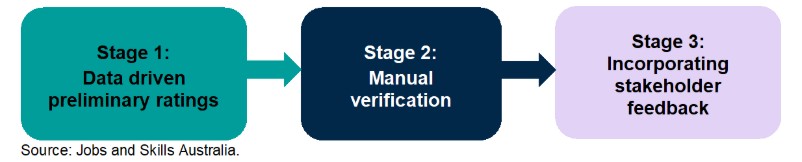
    Image 1: JSA’s three stage occupation assessment process
    Stage 2: Manual Verification

    In this stage of the assessment process, the preliminary occupation ratings are reviewed using both additional labour market indicators and a significant volume of stakeholder evidence that is primarily gathered through the annual OSL stakeholder survey

    Take the survey now to have your voice heard;

    Consultations | Jobs and Skills Australia

    This survey is an important opportunity to contribute your insights on labour market trends. Your feedback will help strengthen the accuracy and relevance of the 2026 OSL.

    The survey will open on Tuesday 20 January 2026 and close on Wednesday 18 March 2026.

    We encourage you to share this with your networks. Greater participation means richer insights and stronger reporting.

  • Miticide Resistance and How to Avoid It

    Do you know what miticide resistance is?

    Miticide resistance happens when some Varroa mites carry genetic traits that make them less likely to be killed by a specific chemical treatment. Within any mite population, there is natural variation — a few individuals may, by chance, have genetic differences (e.g., in proteins or detoxification pathways) that let them survive a treatment that kills most others. If the same chemical is used repeatedly, those surviving mites are more likely to reproduce and pass on those traits. Over time, resistant mites can become a larger proportion of the population, making that chemical less effective or even ineffective.

    This process is a well-understood evolutionary response to repeated chemical pressure. It’s one reason pest-control programs aim to limit how often the same product is used.

    How this changes Varroa Management

    Australian beekeepers should be careful in their Varroa mite management choices to be able to ensure we can control Varroa mites for as long as possible with all the miticide options that we have available to us. If mites in Australia develop resistance to one or more miticides, that means losing an important tool in controlling Varroa populations. Fewer effective treatment options can lead to higher mite levels in hives, increasing colony stress and mortality.


    To avoid the risk of the development of miticide resistance, beekeepers are advised to:

    • Use integrated pest management (IPM) — combining monitoring, cultural/mechanical controls, and chemical treatments only when needed.

    • Apply chemical treatments only when thresholds are exceeded, rather than on a fixed schedule.

    • Rotate between products with different modes of action, so mites are not repeatedly exposed to the same active ingredient.

    • Follow label instructions and dosage, because misuse can accelerate resistance development.

    These approaches help preserve the effectiveness of available treatments for as long as possible.


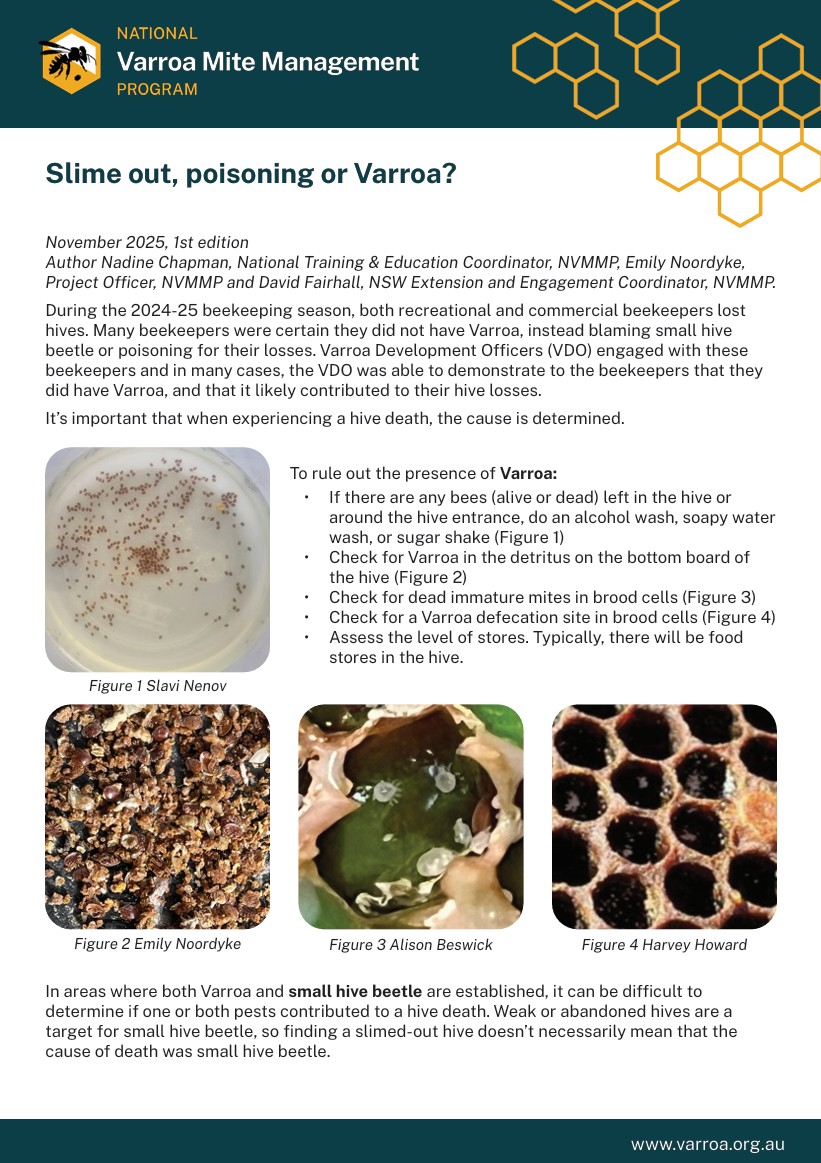
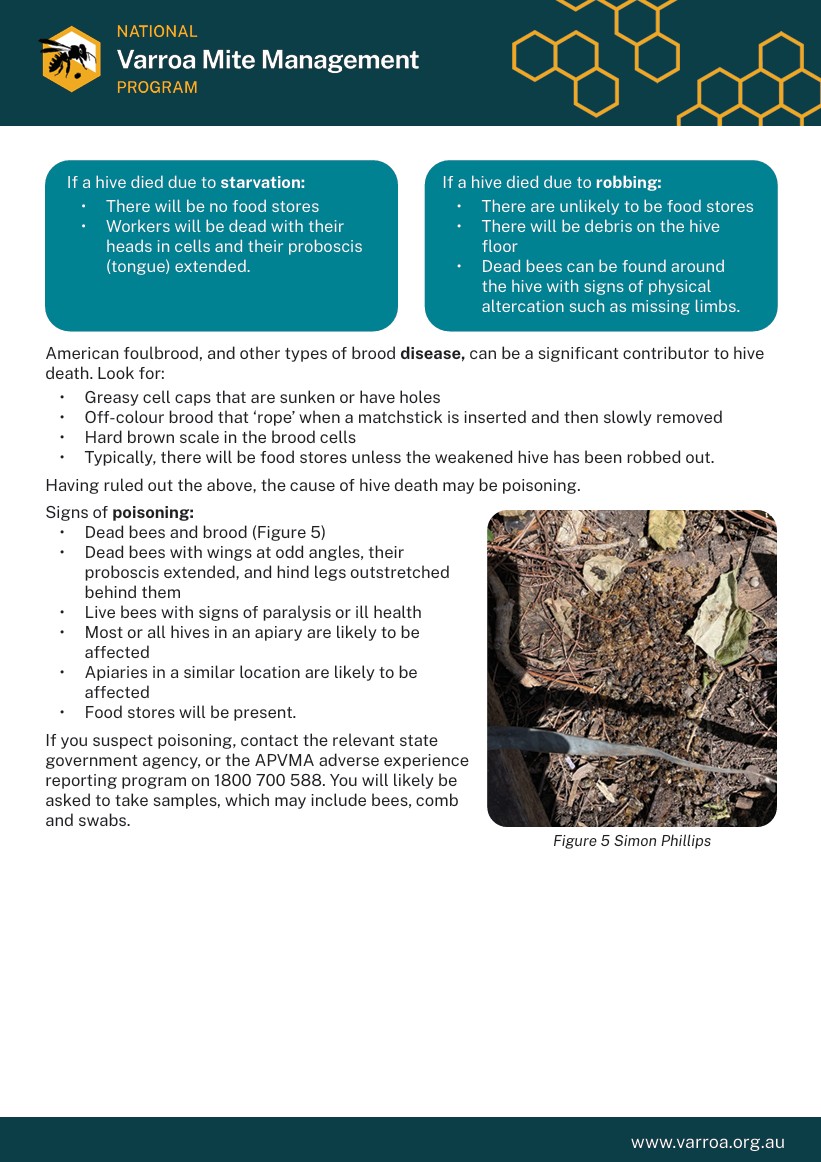
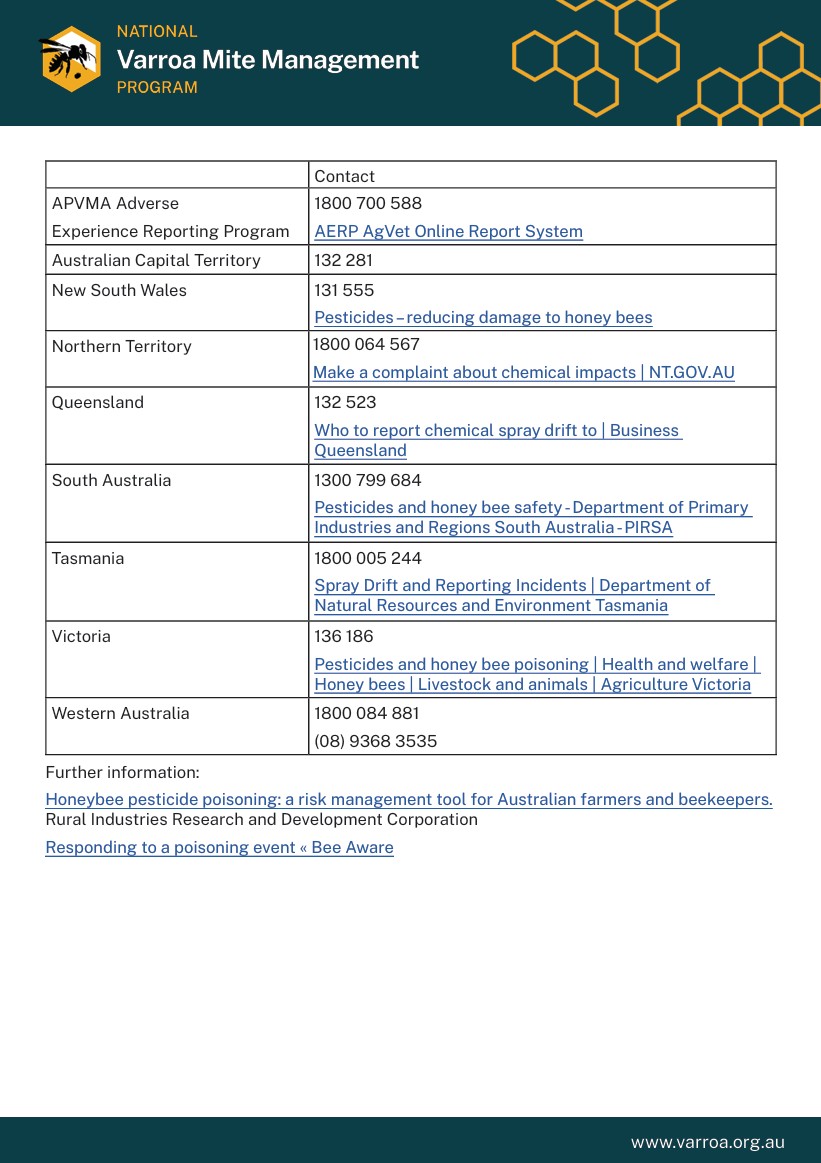
  • Slime out, poisoning or Varroa?

  • Friends of AHBIC

    If you aren’t already a Friend of AHBIC, we welcome you to join our group of organisations and individuals who are supporting Australia’s national beekeeping industry that supports you.

    BECOME A FRIEND

    OUR CURRENT FRIENDS

  • B-QUAL

    B-QUAL is an Industry Owned Quality Assurance System for Australian beekeepers.

    How does B-QUAL certification benefit my business?

    • Product integrity
    • Quality Assurance
    • HACCP based certification
    • Regulatory compliance
    • Industry best practice
    • Biosecurity
    • Access to domestic and export markets

    B-QUAL Certification also enables an enterprise to market its product under the B-QUAL logo to show that it meets the B-QUAL Industry Standards.

    Complete your training at home at your own pace.

    For more information and to obtain a Certification Information Pack, contact the B-QUAL Certification team.

    www.bqual.com.au
    B-QUAL Pty Ltd
    Phone 07 49949820
    Email: admin@bqual.com.au