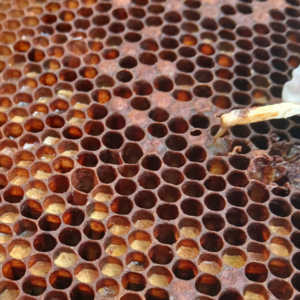
With spring just around the corner and pollination season well underway, its go time for beekeepers. My understanding is that most of the county has received decent rainfall over the winter, despite the forecast of a ‘super el-nino’, let’s hope the rain keeps coming. There are always some areas missing out, areas of Queensland are dry and are calling for rain. Reports that prospects are reasonable across the board. All states have reasonable budding in some areas. I can speak more for NSW, inland is very limited on budding, canola is very early and mostly will be done after almonds, other ground flora looks promising for spring and many areas on the coast are showing good budding. With the challenges of Varroa, let’s hope mother nature is kind to lessen the stress.
Pollination
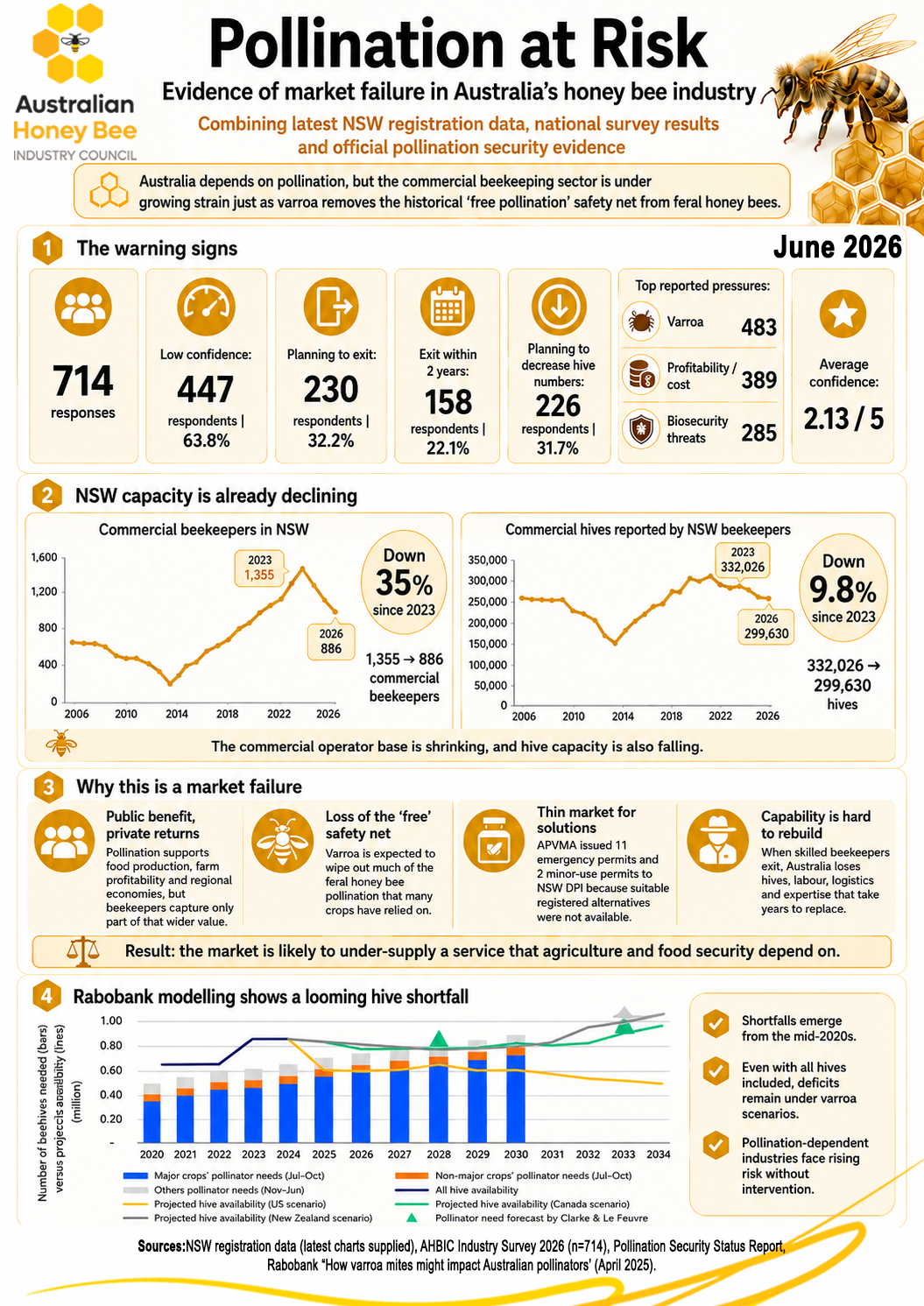
As predicted, we are starting to witness a shift in dynamics within the pollination sector. With the reduction of managed colonies as well as the decimation of the feral population, pollination dependent industries are becoming nervous and more engaged with industry. It is becoming a common sentiment, ‘We are not seeing bees on the flowers like we used to.” A strong collaboration will be required between both sectors to result in success.
It is very concerning to hear in many instances that bee hive audits are not matching up with the hive strength supplied to almond farms. As prices rise, bees are being paid by per frame, auditing correctly will become more of a contentious issue. It is paramount to work closely with your farmer or broker to develop a trustworthy relationship. I encourage beekeepers to be present at the time of audit to encourage accountability. As many reports have been received, AHBIC will be writing to relevant parties expressing concern on behalf of industry.
Imported Honey
The fight for change continues. AHBIC have had several meetings with DAFF of late. The main goal is to get the Government to lift the testing protocols for honey coming into Australia. AHBIC has another meeting next week where pressure will be applied once again.
Previously AHBIC approached DAFF with concerns of a biosecurity risk with imported honey transmitting Deformed Wing Virus (DWV). DAFF stated that there wasn’t enough solid evidence to intervene. Recently an Agrifutures publication by Dr John Roberts ‘Transmission of deformed wing virus (DWV) via imported honey’, displayed that there is a slight risk of DWV being vertically transmitted to bees via honey. As a result, AHBIC have taken the paper to DAFF expressing the concerns. DAFF have acknowledged the possible threat and AHBIC are working closely with them to derive outcomes promptly.
Over the past months, AgriFutures have advertised for several positions on the honey bee and pollination advisory panel. Myself, Amanda Olthof and Samantha Beresford from AgriFutures sat on the selection committee. It was great working with Amanda and Samantha, and they truly demonstrated a deep understanding of our industry. It was fantastic to have received 23 applications for the panel, however, it made our job very hard making the final selections! In October, the new panel will meet in person, I will attend to catch up with the panel to further develop a relationship and demonstrate industries needs in this space.
I hope that all have a good spring, all the best with the mite and look after each other.
Jon Lockwood
AHBIC Chairman
New Research, Development and Extension Plan for the Honeybee Industry
2026 – 2031
The AgriFutures Honey Bee & Pollination Program invests in research, development and extension (RD&E) that improves the productivity, sustainability and profitability of the Australian beekeeping industry and secures the pollination of Australia’s horticultural and agricultural crops.
The R, D & E Plan 2026-31 has been developed in consultation with industry to guide strategic investment over the next five years. It provides a clear framework for RD&E that is focused on practical outcomes for beekeepers. The Plan balances immediate industry needs with longer-term opportunities and will guide investment decisions that maximise value for levy payers, leverages co-investment where appropriate and maintains flexibility to respond to emerging threats.
Priorities & Impact statements
BEE HEALTH, RESILIENCE AND PRODUCTION
NEW AND EMERGING PESTS AND DISEASES
AGRICULTURAL INTEGRATION AND INCOME DIVERSIFICATION
FLORAL RESOURCES AND ENVIRONMENTAL CONDITIONS
PRODUCT DIFERENTIATION AND NEW PRODUCTS
Shaped with industry input
The RD&E Plan has been informed by a comprehensive consultation process, ensuring it reflects both current priorities and future opportunities for the sector.
More than 2,000 industry members were invited to contribute through a national survey, providing insights into key opportunities, challenges and emerging trends. This was complemented by targeted engagement with key stakeholders and the AgriFutures Honey Bee & Pollination Advisory Panel. Scenario planning workshops held in Queensland and South Australia brought industry representatives together to test potential directions and explore future scenarios. Ongoing engagement with the Australian Honey Bee Industry Council (AHBIC) further strengthened and refined the Plan as it evolved. A draft Plan was also shared more broadly, including through a webinar, allowing stakeholders across the industry to provide feedback prior to finalisation.
AHBIC Chair Jon Lockwood said RD&E remained critical to the long-term success of Australia’s honey bee and pollination industry.
On the new plan, AgriFutures spoke with AHBIC Chair person Jon Lockwood who has said:
“RD&E plays a vital role in helping Australian beekeepers respond to current challenges and remain competitive and resilient into the future. This Plan sets a clear direction for investment in the priorities that matter most to industry, ensuring levy funds are directed towards outcomes that strengthen productivity, resilience and long-term sustainability”
A current request for quote is also open until 22 September:
Deliver practical impacts for the honey bee and pollination industry
AgriFutures invites proposals that address one or more of the priorities and strategies outlined within the AgriFutures Honey Bee & Pollination Program RD&E Plan 2026-31, or within the Varroa destructor Research Strategy 2024-2027. Proposals should focus on delivering short-term research projects, extension or training (~18 months) with immediate practical implications for industry.
Where applicable, proposals should clearly indicate the following:
The project benefits and impacts for the Australian honey bee and pollination industry.
The objectives and outcomes of the proposed project and the link to the RD&E and/or Research Strategy objectives.
Who will be undertaking all aspects of the work (it must be clear if new staff and/or students are to be employed to undertake the work).
The plan for extension and adoption of research outcomes from the project activity work, i.e. beyond distribution of summaries, journal papers and conference presentations.
Where relevant, any proposed collaboration with experts in the field.
The researcher’s understanding of past research in this field.
The indicative budget for all projects included in this round of funding is up to $230,000. The expected timeframe for completion from commencement is up to approximately 18 months.
This Request for Quote closes on Tuesday, 22 September 2026 at 12 pm AEST.
AFB – Bee Informed, from our WA Bee Biosecurity Officer: Shannon Holt
Spring build-up…or hidden trouble?
Article by Shannon Holt, Bee Biosecurity Officer DPIRD WA
Spring is one of the busiest times in the apiary. Colonies are expanding rapidly, brood nests are growing and management activities are ramping up. While colonies may appear healthy and productive, hidden problems can also emerge, particularly American foulbrood disease (AFB), caused by the bacterium,Paenibacillus larvae. However, AFB doesn’t always present in the textbook way many beekeepers expect. Knowing what to look for and carrying out thorough brood inspections in spring can make all the difference to detecting AFB before it spreads.
Best practice, as outlined in the Biosecurity Code of Practice, is to conduct detailed brood inspections at least three times a year: spring, summer and autumn. Spring inspections are particularly important because they often provide the first opportunity to detect AFB following winter.
Why spring reveals what winter hides
Spring doesn’t cause AFB infections. However, seasonal changes in colony behaviour and increased management activities can make previously hidden infections more obvious and increase the risk of disease spreading within an apiary.
Colony dynamics
If AFB spores are present in a colony’s honey or pollen stores, the rapid increase in brood rearing during spring increases the likelihood they will be fed to young larvae. Research shows as little as 6–10 spores may be sufficient to infect a one-day-old larva. As nurse bees feed larvae and clean brood cells, they can inadvertently distribute spores more widely through the brood nest.
Spring can also bring periods of nutritional stress due to variable weather, interrupted nectar flows or limited forage, particularly as colonies rapidly expand. Weakened colonies are more vulnerable to robbing, one of the main ways AFB spreads between hives. Increased bee traffic and drifting within apiaries can create additional opportunities for disease transmission.
Beekeeper activity
“You can’t find what you don’t look for.”
Brood inspections are often limited over winter, so spring may be the first thorough inspection carried out in several months. As a result, many cases of AFB are first detected during spring inspections. Spring management activities such as colony splitting, honey harvesting and transferring frames can also spread AFB if good biosecurity practices aren’t followed.
Recognising AFB: Common signs 🔍
The following signs commonly occur in colonies affected by AFB, although not every infected colony will display all of them.
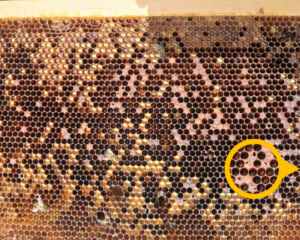
Spotty or irregular brood pattern, with perforated brood cappings, holes are often off-centre.
Spotty or irregular brood pattern, photo-credit_DPIRDWA
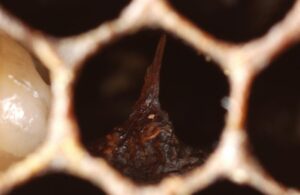
Protruding pupal ‘tongue’, where brood has developed to the pupal stage before dying.
Pupal tongue – Courtesy The Animal and Plant Health Agency (APHA), Crown Copyright
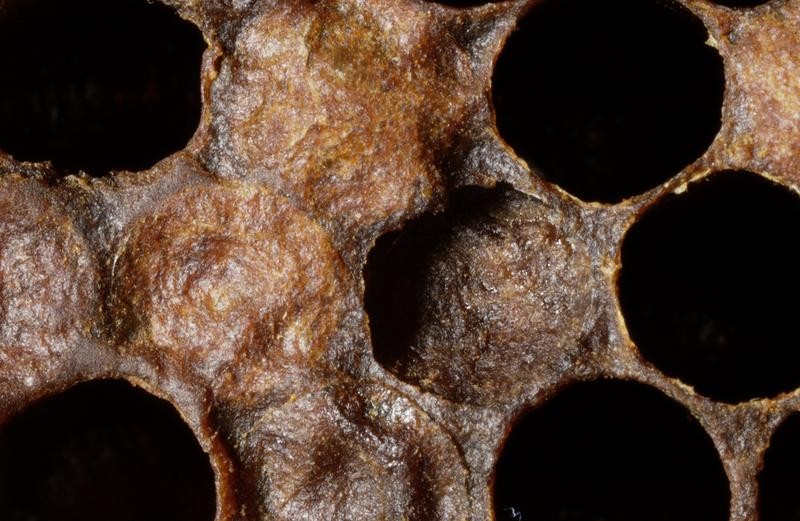
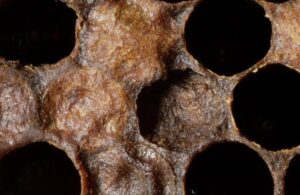
Dark, sunken cappings that may appear greasy.
Dark sunken cappings – Courtesy The Animal and Plant Health Agency (APHA), Crown Copyright
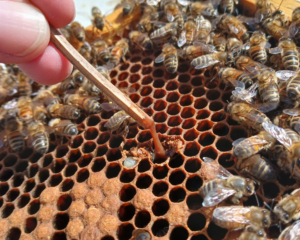
Decaying Larvae form a light to dark brown, semi-fluid mass which can stretch in to a smooth, elastic rope when tested with a stick (ropiness test).
Roping_cropped_Photo credit_DPIRD
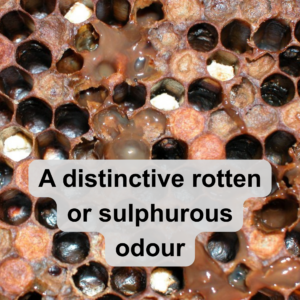
Rotten or suplhurous odour_The Animal and Plant Health Agency (APHA), Crown Copyright. Adapted by author.
What if you suspect AFB but it doesn’t rope?
Ropiness is a useful field diagnostic because no other brood disease produces the same characteristic rope. It occurs only during a specific stage of larval decomposition, when diseased brood breaks down into a sticky, glue-like mass.
To perform the test, insert a matchstick into a suspect cell, stir gently, then slowly withdraw it. If the brown larval remains stretch into a smooth rope approximately 3–5 cm long, AFB is confirmed.
A negative ropiness test does not rule out AFB. There is only a limited period during which infected larvae will rope:
Too early: the larva has not yet reached the ropey stage (commonly less than 8–12 days post-infection*)
Too late: the larval remains have dried into a hard scale (commonly more than 3–4 weeks after infection*)
*Disease progression also depends on the age of the larva at infection, spore dose and AFB strain.
Watery AFB_cropped_Photo credit DPIRD
If you suspect AFB, even if larval remains are not roping:
Look for other symptoms described above
Examine multiple cells, as some may be at a different stage of infection and more likely to rope
Recheck suspect frames for ropiness several days later
Isolate the hive and reduce the entrance to minimise robbing
Avoid moving equipment between colonies
Clean tools and hands or gloves before working other hives
Contact DPIRD for assistance with sample collection and laboratory testing.
If AFB is confirmed, either through visual diagnosis or laboratory testing, the affected hive must be euthanised and all associated equipment destroyed or appropriately sterilised. AFB is a declared and reportable disease, and all detections must be reported to DPIRD as soon as practicable.
Biosecurity reminders
✅ Maintain clear hive-group barriers and avoid swapping supers, frames, or comb between these hive groups.
✅ Clean hive tools between hives or hive groups.
✅ Carefully inspect brood during spring build-up and investigate any unusual brood patterns or signs of disease.
🧬 Why some AFB infections are harder to spot
Two strains of the AFB bacterium are known to occur in Western Australia. These strains differ in how quickly they kill larvae, which influences the signs beekeepers see during brood inspections.
Strain I typically produces the classic signs associated with AFB. Infected larvae usually die around 12 days after infection, after the brood cell has been capped1,2. This allows symptoms such as sunken or perforated cappings and protruding pupal tongues to develop. Many infected larvae remain in the hive long enough to become ropey and eventually dry into scales.
Strain II can be much harder to detect. Infected larvae usually die just 3–7 days after infection, often before cells are capped¹⁻³. As a result, classic signs such as sunken cappings, perforated cappings and protruding pupal tongues may never develop. Research has also shown that hygienic bees remove around 90% of Strain II-infected larvae before 13 days post-infection, compared with about 64% of larvae infected with Strain I³. Many infected larvae are therefore removed before they become ropey or dry into scales.
The key message is that not all AFB infections display the classic signs. While sunken cappings, ropiness and scale remain important indicators, their absence does not rule out AFB. Colonies infected with Strain II may show only subtle signs, such as an irregular brood pattern, making careful brood inspections and laboratory testing particularly important whenever something doesn’t look right.
A case study: An unusual presentation of AFB
Earlier this year, an experienced beekeeper noticed something wasn’t quite right in one of their nucleus colonies. The queen appeared to be failing, resulting in a shrinking brood nest and declining adult bee numbers. The weakened colony also developed secondary problems, including chilled brood and chalkbrood.
Although these issues could readily explain the colony’s condition, the beekeeper remained suspicious of AFB. There was a faint decaying odour, and dead larvae were present in both capped and uncapped cells. Brown larval remains were visible, but the ropiness test was negative.
It would have been easy to conclude that the colony was simply suffering from queen failure and its associated complications. Instead, samples were submitted for laboratory testing, which later confirmed AFB.
This case illustrates that multiple problems can occur in the same colony, and AFB does not always present in the textbook manner. When brood abnormalities cannot be fully explained, or something simply doesn’t look right, laboratory testing can help detect infections that might otherwise be missed.
Rather than waiting for laboratory confirmation, the beekeeper treated the nuc as a suspected AFB case and acted immediately. The affected nuc was isolated, repeated brood inspections were carried out across all the beekeeper’s apiaries, and proactive Honey Culture Tests (HCT) were undertaken. Thanks to this early response, no additional cases of AFB have been detected in the six months since the initial diagnosis.
Get ahead of AFB – Honey Culture Tests
HCT is particularly valuable because it can detect AFB before obvious clinical signs develop. Used alongside barrier systems, good hive hygiene and strong biosecurity practices, HCT can provide important information to help reduce the spread and impact of AFB within your apiary.
Beims, H. et al. (2020). Discovery of Paenibacillus larvae ERIC V… International Journal of Medical Microbiology.
Genersch, E. (2005). Strain- and Genotype-Specific Differences in Virulence of Paenibacillus larvae… Applied and Environmental Microbiology.
Rauch, S. et al. (2009). Negative Correlation between Individual-Insect-Level Virulence and Colony-Level Virulence of Paenibacillus larvae…Applied and Environmental Microbiology.
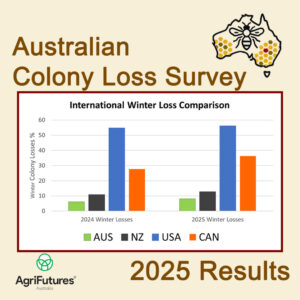
2026 Australian Colony Loss Survey : opening soon!
The 2026 Australian Colony Loss Survey is back!
The Australian Colony Loss Survey established in 2025, provides empirical data to support Australian beekeepers to make informed business decisions, particularly regarding the management of honey bee pests and diseases. The results of the survey are used to facilitate national extension efforts and peer-to-peer learning and knowledge transfer from beekeeper to beekeeper. The survey provides a baseline for colony health and management practices, allowing beekeepers to benchmark their own operations and help them to adopt best practice management.
Through fit for purpose extension materials, and clarity in messaging for specific target audiences (e.g. commercial beekeepers), this project will demonstrate what impact pests, diseases and management practices are having on hive health, and what mitigation techniques are working for beekeepers.
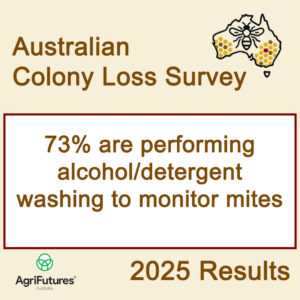
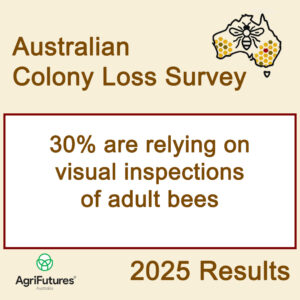
Over 750 beekeepers from across Australia took part in the 2025 Survey, giving us vital information about the most important current issues in Australian beekeeping. In this 2026 round, we’re hoping to hear from even more beekeepers!
The Survey is your chance to tell the industry, government and researchers about the biggest challenges you faced as a beekeeper in 2026. Together, we can work out management strategies for them that will ensure a vibrant Australian honey bee industry for the future.
The survey is for anyone and everyone who keeps bees anywhere in Australia and is completely anonymous.
The Project will be lead by Bianca Giggins from the Australian Honey Bee industry Council, and the team will build on previous surveys to further refine the questions to provide invaluable longitudinal data allowing industry and researchers to track and identify emerging threats and trends.
If you aren’t already a Friend of AHBIC, we welcome you to join our group of organisations and individuals who are supporting Australia’s national beekeeping industry that supports you.