Honey Bee
← Back

Newsletter Edition - June 2026

  • 2026 Honeybee Industry Conference Bursary – thanks to AgriFutures Australia

    Building the next generation of industry leaders and researchers is critical to ensuring the resilience, productivity and sustainability of the Australian honey bee industry. 

    State apiculture conferences play a vital role in the industry ecosystem. They provide a unique opportunity for beekeepers, researchers, suppliers and industry organisations to come together to: 

    • share knowledge and emerging research 
    • discuss current industry challenges 
    • showcase innovation and technology 
    • strengthen professional networks across the sector.

    AHBIC was successful in receiving support from AgriFutures Australia’s “capacity building grants” earlier in May 2026.

    There were 8 successful 2026 Honeybee Industry Conference Bursary Recipients, 4 researchers and 4 beekeepers who demonstrated they were early stage career, held practical European honeybee experience and a passion to progress a career in the honey bee industry into the future.

    The bursary opened an opportunity for individuals to attend a state beekeeping conference and network throughout the events, establishing a solid foundation of future associates and colleagues across the honey bee industry.

    This project contributed directly to strengthening the future workforce capacity of the Australian honey bee industry.

    By supporting early-career beekeepers and researchers to attend industry conferences, it helped accelerate the professional development of emerging industry participants. It also strengthened connections between industry and research, while building confidence and leadership capability among the next generation of contributors. In addition, it increased awareness of key national priorities such as biosecurity, pollination services, and emerging research.

    Importantly, the program helped establish a cohort of engaged early-career participants who are now more likely to remain active in the honey bee sector and contribute to its long-term sustainability.

    For researchers, the opportunity to engage directly with commercial beekeepers ensured that future research was better grounded in real industry needs. For beekeepers, exposure to new research and technologies supported improved on-farm decision-making.

    Overall, the initiative provided a practical and effective way to strengthen knowledge exchange, capability development, and collaboration across the honey bee industry workforce.

    We are thrilled to share some reflections from the participants:

    “The networking opportunities opened meaningful collaborative pathways. I made contact with beekeepers eager to trial my strategies, with some extending invitations for site visits to explore using their hives in future experiments. Connecting with fellow researchers also provided important scientific feedback and practical guidance on engaging with industry and communicating findings effectively.”

    “The conference also allowed me to meet and speak with other beekeepers, including commercial operators and hobbyists, who are dealing with varroa, resistant mites, colony losses, and the emotional and financial pressure now facing the industry. Those conversations were extremely valuable because they helped me understand that the challenges I am seeing locally are part of a much larger industry-wide issue.”

    “As an early-career researcher working on Varroa, feral honey bees and industry biosecurity, the opportunity to speak casually with beekeepers, researchers, industry representatives and policy-focused organisations gave me a clearer understanding of the practical challenges facing Australian beekeeping. These conversations helped me see where my research can be most useful and how it can better support industry needs. It also helped me build confidence introducing myself, explaining my project, and identifying future collaboration pathways.”

    New South Wales Apiarists Association
    2026 Bursary Recipients at NSW Apiarists Association Conference in Bathurst: Blake Williams, Jessica Deurinck, Sara Bryant and Oliver Holloway.
    Victorian Apiarists Association
    2026 Bursary Recipient Victorian Beekeepers Association in Melbourne Casey Forster.
    Queensland
    2026 Bursary recipients: “Nader Sallam, Jamie Martin, Olivia Ducommun-dit-verron at the Queensland Beekeepers Association in Bundaberg.


    A big thank you to AgriFutures Australia for awarding the grant under the People and Capability Program. Without your support, AHBIC would not have been able to provide this valuable industry bursary, which has been a fabulous opportunity for the future workforce and innovative thinkers among industry.

  • Supporting Beekeepers Through Challenging Seasons

    Australia’s beekeeping industry plays a vital role in agriculture, food production and regional communities. Many beekeepers are currently facing ongoing challenges, including the impact of varroa mite, rising operational costs, biosecurity concerns and seasonal pressures.   

    At Rural Aid, we understand that hardship can affect all primary producers, including apiarists.  

    Our financial assistance program is available to support eligible primary producers experiencing hardship due to drought, flood, fire, biosecurity events and other significant challenges. This assistance can help ease immediate pressures and provide some support as producers manage their operations and plan ahead.   

    In addition, Rural Aid offers wellbeing support services and works alongside rural communities through a range of programs designed to help people navigate difficult seasons.   

    If you are a beekeeper experiencing hardship, or know someone who may benefit from support, we encourage you to reach out. 

    Rural Aid is here to support farmers, families and rural communities through every season. 

    Learn more about available support: www.ruralaid.org.au 

    Need assistance? Contact our team:1300 327 624


  • AHBIC Biosecurity Update – Resistant Varroa Mite – 18 June 2026

    18th June 2026

    Resistant Mite Spread Map

    The spread of resistant mites across the eastern seaboard has been traced and confirmed through the joint effort of affected beekeepers and state governments, along with comprehensive laboratory testing. As feared, the spread of both pyrethroid and amitraz resistant varroa mites are now clearly affecting the eastern mainland states.

    The below map, courtesy of QLD DPI, dated 4 June 2026, clearly shows confirmed resistant properties in blue, spread from Queensland, through NSW, Victoria and South Australia.
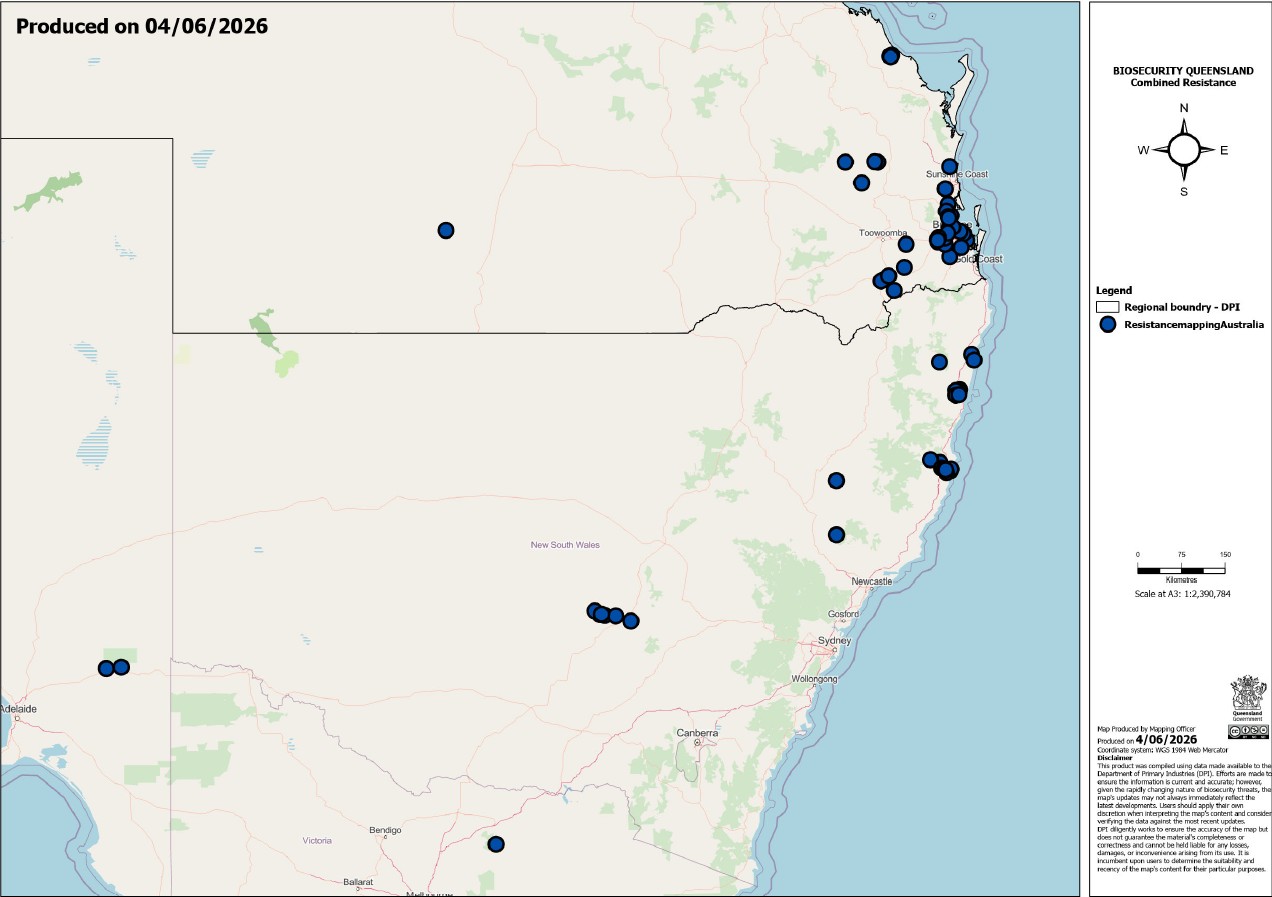
     

    It is important to note that the map represents only government lab confirmed information, and it is believed there could be additional locations likely to be impacted than what appears on the map itself.

    Key Priorities for Beekeepers

    Beekeepers should anticipate the increased spread of synthetic resistant mites across the eastern seaboard over time. All beekeepers will eventually have lower efficacy from key synthetic control tools, and there will become an increased risk of high mite loads and colony losses across Australia.

    The messaging remains consistent, it is more important than ever to ROTATE modes of action, and MONITOR mite numbers before, during and after miticide treatments and implement IPM strategies for varroa management.

    If you suspect that pyrethroid or amitraz resistance-carrying mites are in your apiaries or in your area, you should act swiftly to test your colonies via state Bee Biosecurity Officer assistance or privatised testing facilities. Confirmed synthetic treatment failures will require changing management practices including integrated pest management and using primarily organically derived treatments to give your colonies the best chance of survival.

    Refer to AHBIC Biosecurity Update 29th April here for resistance management advice.

    It is never too early to test for resistance, be proactive to ensure colony survival. 

    Whilst testing is being offered by jurisdictions, AHBIC has been advocating for alternative testing options for determining resistance status in your hives that offers both economical and rapid commercial testing for resistance.

    If you suspect resistance and are interested in testing, keep the contents of your mite wash.

    Privatised testing is now available via D-central, details on their website D-central or email:  beehealthy@d-central.au phone:  (02) 8065 3994.

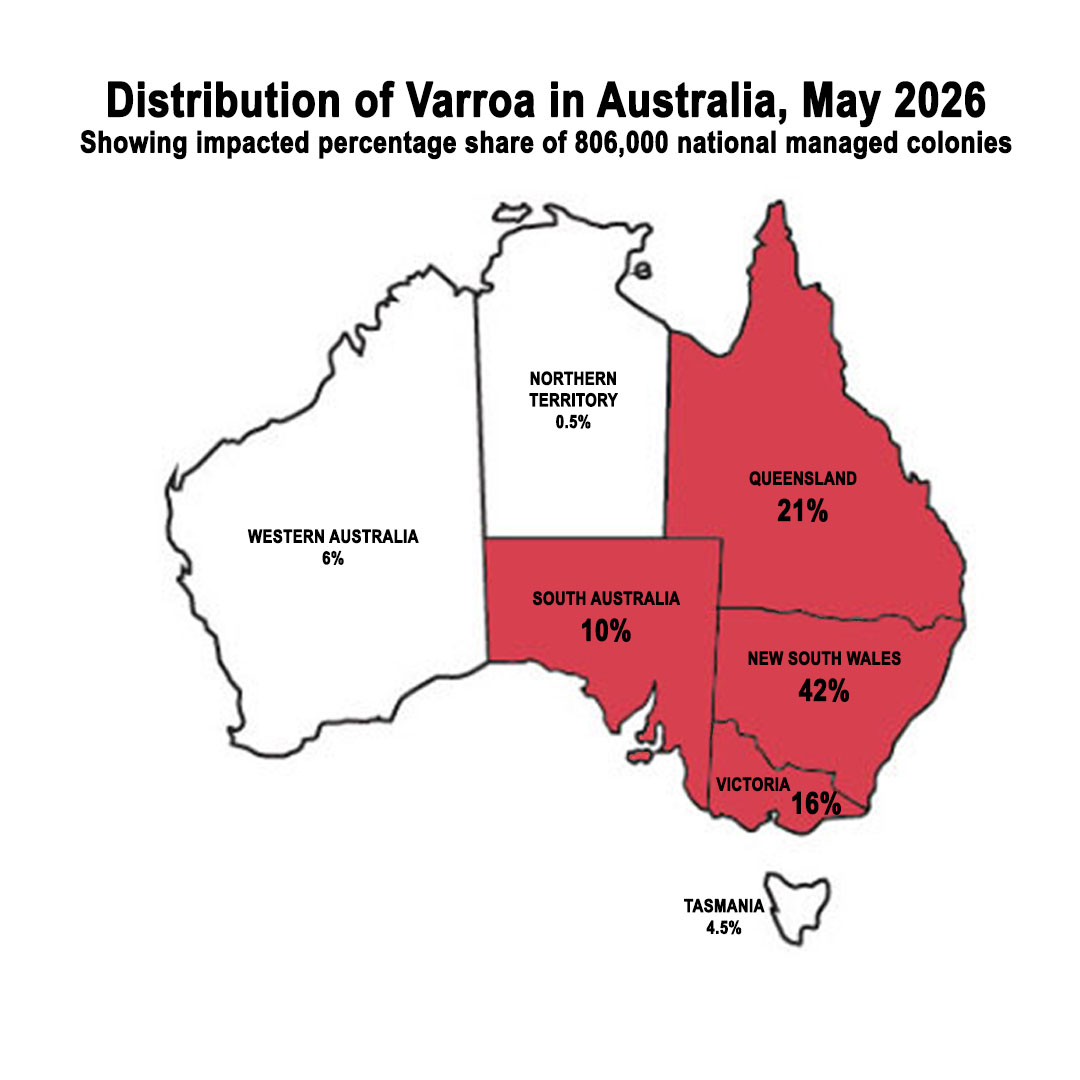
    National Varroa Mite Spread Update

    Confirmation of Varroa mite presence across Australia’s eastern states is represented in the below image. Highlighted in red, the states which are experiencing widespread varroa infestation as well as the percentage of national hive numbers within the state is listed.
    Taking Care of Yourself and your Mates

    We acknowledge that these ongoing challenges for our industry can be incredibly difficult to navigate. We encourage you to reach out to available resources for professional support if you feel you need it.


    CLICK HERE TO OPEN This Update IN PDF


    Refer to the AHBIC Varroa Chemical Treatment Table for a quick guide to modes of action and better treatment understanding.

    Bianca Giggins

    Industry Development Manager

    0402 467 780

    bianca@honeybee.org.au

    AHBIC, its employees, executive and consultants expressly disclaim all and any liability to any person in respect of anything, and the consequences of anything, done or omitted to be done in reliance, whether wholly, partly, upon the whole or any part of the contents of this industry update document.